
South Africa’s experience confronting the legacies of apartheid has played a significant role in the development of the transitional justice field. However, much has been lacking and accountability for many issues has yet to be achieved. ICTJ has worked in the country to support victims’ rights and challenge impunity for perpetrators.
South Africa
Image
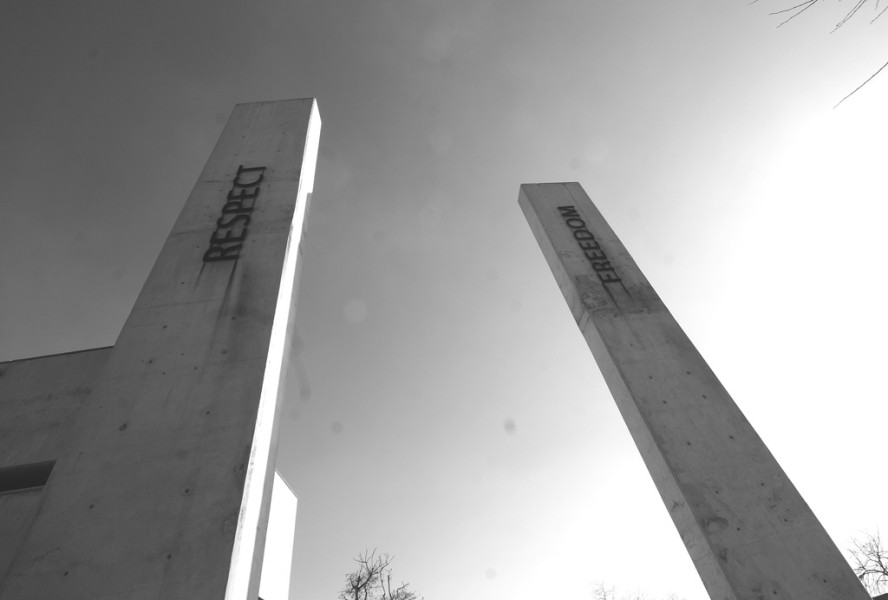
The Apartheid Museum in South Africa. (Photo from Flickr by teague_o)
Past
Background: Facing Apartheid’s Legacy
More than forty years of apartheid has cast a long shadow of human rights violations, including massacres, torture, lengthy imprisonment of activists, and crippling racial discrimination.
Nelson Mandela’s release in 1990—after 27 years in prison—led to negotiations between South Africa’s apartheid government and the African National Congress, and elections in 1994.
In 1995, the South African Parliament mandated the establishment of the Truth and Reconciliation Commission (TRC). The TRC’s report, published in 1998, included testimony from over 22,000 victims and witnesses. More than 2,000 testified at public hearings.
But most other efforts to respond to victims’ rights and pursue individual criminal responsibility for crimes committed during apartheid have failed:
- The TRC law authorized a controversial offer of "amnesty for truth" to perpetrators of human rights abuses who were willing to confess.
- Former President Thabo Mbeki’s presidential pardons process—publicly described as a means for resolving “the unfinished business of the TRC”—conducted secret proceedings which excluded victim representation.
- Amendments to the National Prosecuting Authority’s Prosecution Policy provided for a “back-door amnesty” that effectively granted impunity for apartheid-era perpetrators who had not applied for the TRC’s amnesty.
During 2008, the Pretoria High Court declared the Prosecution Policy’s amendments unconstitutional. In 2010, the Constitutional Court upheld victims’ rights to be consulted before political pardons were granted. ICTJ was an applicant in both these landmark cases.
Despite the striking down of such impunity promoting measures, not a single case recommended for prosecution is before the courts today. Notwithstanding the requirement of the Constitutional Court, no meaningful consultation with victims on the question of political pardons has taken place.
Reparations
Most of the recommendations on reparations made by the TRC – including the yearly payment to survivors of R21,000 for six years and the collection of a ‘wealth tax’ to fund reparations from industries that benefited from apartheid -- were not implemented by the State. Instead the government established a reparations fund with money from the State and from donors; using this fund, it paid a lump sum of R30,000 each to about 23,000 persons who registered with the TRC as ‘victims’. It has also provided around R800,000 in reburial expenses to 47 families of disappeared persons whose remains were found and reburied.
As of 2013, the reparations fund stands at around 1 Billion rand. The government has proposed to use part of this for medical and higher education assistance to the same TRC-registered victims that earlier received compensation. It has also proposed to fund ‘community rehabilitation projects’ in economically-distressed communities.
Victims and survivors have criticized both policies, and have argued that medical and higher education assistance should be given as well to around 30,000 more survivors who, for various reasons, were not able to register with the TRC. It has also asked that individual compensation should get equal priority over community reparations and that the selection of communities for the latter program should be done in consultation with survivors organizations.
Various examples of symbolic reparations have been initiated since the end of the TRC by both State institutions and non-government organizations, including freedom parks, museums, and the naming and renaming of public places.
International Corporate Accountability and Reparations
In 2002, the Khulumani Support Group, a South African victims' organization, sued 23 multinational corporations , in a United States district court, seeking civil damages for their role in human rights violations committed during apartheid. The corporations are alleged to have aided and abetted apartheid by supplying specialized transportation, software and other equipment used in suppressing opposition to apartheid and in implementing racial segregation
In 2007, the U.S. district court allowed the case to proceed against Ford Motor Company, General Motors, and IBM. GM, under bankruptcy, settled with the victims’ groups. After the remaining defendants appealed, the case was dismissed in 2013, citing a separate US Supreme Court decision that limited accountability for human rights violations committed outside the United States. Recently, however, the district court said it would allow the victims’ groups to file a new suit based on the Supreme Court’s new standards.
ICTJ's Role
ICTJ's Cape Town office was opened in 2004 and closed in 2011.
- In 2007–2008, we played a central role in the successful legal challenge to the amendments to the National Prosecuting Authority’s Prosecution Policy which provided for a backdoor amnesty.
- We have supported victims in their struggle to have their cases seriously considered by the prosecution authorities.
- During 2008–2009, we took legal action for transparency and victim participation in the presidential pardons process. The Constitutional Court upheld the rights of victims to be heard in the process.
- We continue to support the South African Coalition for Transitional Justice (SACTJ), an umbrella body of organizations working to advance the rights of victims of past conflicts and to hold government accountable to its obligations.
- We supported victims in their successful petition before the Constitutional Court to uphold their rights to express the truth.
- We support victims' claims in the Khulumani lawsuit against multinational corporations accused of supporting the apartheid regime. We filed an amicus brief supporting the right of victims to have the case heard in the United States.
- We are working with the SACTJ to develop a strategy to persuade the government to provide adequate reparations to all victims of gross human rights violations.
