
Through its Truth and Reconciliation Commission, Canada has been responding to the devastating legacy of Indian Residential Schools. ICTJ supported the Truth and Reconciliation Commission from its inception, and has worked to spread its lessons to a new generation.
Canada
Image
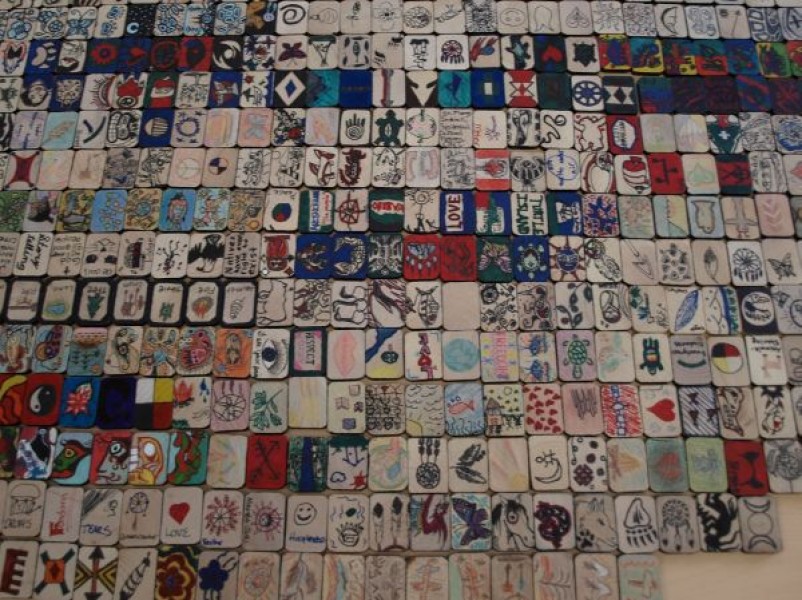
Tiles representing Indian Residential School students who lost their lives as a result of their experience in the schools. (Photo from Flickr by projectofheart)
Past
Background: Taken From Their Homes, Subjected to Abuse, Forced to Assimilate
Since 1874, Canada attempted to assimilate indigenous children by forcing them to attend church-run Indian Residential Schools (IRS). More than 150,000 children were taken from their families and communities and sent to schools where:
- Physical, sexual and emotional abuse was commonplace
- Students were prohibited from speaking their native language
- The practice of their cultural traditions was forbidden
By 1920, attendance at an IRS was compulsory for indigenous Canadian children. Resistance gradually mounted over the years and they were eventually discredited and discontinued, but it was only in 1996 that the last school closed.
From the 1990s, former IRS students publicly denounced the experiences of abuse they had suffered in the schools and started a movement of massive litigation.
In 2006, after years of negotiations, the federal government, churches, and indigenous groups agreed to a $2 billion settlement package for the estimated 80,000 survivors of these schools.
The package included the establishment of a truth commission—the first-ever created by a judicial process—and reparations for survivors.
Canada’s Truth and Reconciliation Commission (TRC) was established in June 2008. Its mandate is to learn the truth about what happened in the residential schools and inform all Canadians of these findings. At the time of establishing the commission, the Canadian government issued a formal apology to the indigenous peoples for the policy of “Killing the Indian in the Child”.
On February 24, 2012, the TRC released its interim report and a new historical publication titled, “They Came for the Children; Canada, Aboriginal Peoples, and Residential Schools” in Vancouver.
There has been an ongoing active effort to include children and youth in education and awareness programs involved with the TRC. Starting with the Atlantic National Event in October 2011, the TRC added one full day dedicated to reaching the younger generations through “Education Day.” Since then, “Education Day” has been a core part of subsequent national events (Saskatoon, SK - June 21 - 24, 2012, Montréal, QC - April 24-27, 2013, Vancouver, BC - September 18-21, 2013). The most recent Education Day in Vancouver brought together close to 5,000 high school and middle school students to introduce them to the history and legacy of Indian residential schools through a variety of activities including dialogue, displays, and films.
As the TRC neared the conclusion of its mandate, it continued to gather and share the truth about the past throughout the residential schools and to inform all Canadians about this history. During this process of completion, the Truth Commission created and produced a final report, which synthesized several years’ worth of information gathered during the TRC’s activities.
ICTJ's Role
ICTJ worked in Canada since 2005 to help the country face its past, reflect on its identity and empower a new generation.
-
Technical advice: ICTJ has provided technical advice to the Truth and Reconciliation Commission (TRC) on topics such as the taking of statements and issues of consent. ICTJ also responded to requests for advice and help by the Assembly of First Nations (AFN) and other groups working on the settlement process and indigenous rights.
-
Engaging communities: ICTJ has helped disseminate the work of the TRC throughout the country participating in seminars and through press work.
-
Sharing knowledge: We participated in the TRC’s inaugural event in June 2010, and several subsequent events as an honorary witness. We met with the public and with Aboriginal and First Nation peoples, responding to queries about transitional justice and how it can help Canada’s process.
-
Empowering a new generation: Since 2010, the ICTJ has worked in partnership with the TRC of Canada to devise a youth engagement strategy and conduct a number of targeted activities to promote youth participation in the TRC. From the first youth retreat held in October 2010, two of the participants produced a video which was presented at the Inuvik National Event and has since led to and been included in a revised curriculum on the topic of IRS in the Northern Territories and Nunavut. The group of youth reporters we supported at the Atlantic National event, created their own video which was later screened at the UN Permanent Forum on Indigenous Rights in NY in March 2012. With the aim of reaching an even broader group of youth, we then created the youth forum model implemented in Saskatoon, Montreal, and Vancouver, in which youth have a chance to make recommendations to policy makers in their region. According to the Aboriginal students who took part in these activities, these initiatives enabled them to place their own experiences of racism in a historical context, and inspired them to learn more about their grandparents’ past, and for non-Aboriginal students it helped them better understand their own country’s past; a past seldom discussed either at home or in school.
