
The legacy of the former Yugoslavia’s armed conflicts in the 1990s continues to affect the regional human rights climate, the rule of law, and reconciliation efforts. ICTJ advised and assisted the implementation of both national and regional transitional justice.
The former Yugoslavia
Image
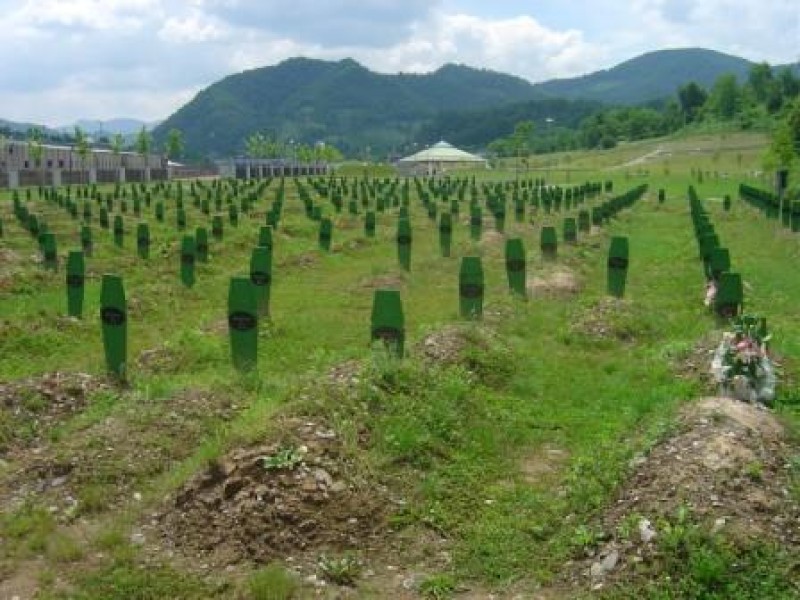
Srebrenica-Potočari Cemetery to Genocide Victims in Bosnia and Herzegovina. (Louis Bickford)
Past
Background:
Throughout the 1990s, as Yugoslavia broke apart, its territories—including Croatia, Bosnia and Herzegovina (BiH), Macedonia and Kosovo—were battlegrounds for the most serious conflict and abuses in Europe since World War II.
The abuses included widespread attacks against civilians, population expulsions, systematic rape, and the use of concentration camps. Between 1991 and 2000, more than 140,000 people were killed, and almost four million others were displaced.
Accountability for these mass atrocities continues to be sought, through international, national and regional mechanisms. In 1993, the UN Security Council established the International Criminal Tribunal for the former Yugoslavia (ICTY), an ad hoc tribunal mandated to prosecute war crimes committed in the region since 1991. The tribunal has indicted 161 persons and has finished proceedings against over 100 defendants.
In July 2013, the ICTY officially ended its mandate. The ongoing appeals as well as the cases of four defendants still on trial for war crimes and crimes against humanity (Radovan Karadzic, Goran Hadzic, Ratko Mladic, and Vojislav Seselj), will continue through what is known as a “a residual mechanism.” More recently, the ICTY came under heavy criticism following controversial acquittals on appeal of Croatian generals Ante Gotovina and Mladen Markac, and former Yugoslav army chief Momcilo Persisic. These decisions, and in particular the legal reasoning on the issues of what suspects need to know and do in order to aid or abet crimes, have stirred intense debates in legal circles and cast a shadow of doubt over the legacy of the tribunal in the region.
Some national courts were established to try war crimes, such as special chambers at Serbia’s District Court of Belgrade in 2003 and the Court of BiH in 2005. However, these courts have faced various challenges, including insufficient witness protection, lack of transparency, and susceptibility to political pressure.
Various other steps to recognize the dignity of victims and restore the rule of law have been deployed in the region. Memorials throughout the region—such as the Potočari memorial in Srebrenica—pay tribute to some victims of the violence. Some reparations programs have been created, although these have been criticized for favoring former combatants and victims of dominant ethnic groups.
The issue of the missing continues to haunt the region: at the time hostilities ended, an estimated 35,000 people were unaccounted for. As of August 2013, approximately 11,800 families were still waiting for answers regarding the fate of their loved ones. Over 7,000 of these cases are related to the conflict in Bosnia and Herzegovina, over 2,000 related to the conflict in Croatia, and over 1,500 are related to conflict in Kosovo. In 2004, Bosnia and Herzegovina created and adopted the “Law on Missing Persons,” which defines the status and rights of the families of missing persons and the obligation of the authorities to account for all missing persons by providing information and support to the MPI.
A significant campaign spearheaded by NGOs and civil society is ongoing to establish the Regional Commission for Establishing Facts about War Crimes and Other Gross Violations of Human Rights Committed on the Territory of the Former Yugoslavia, or RECOM. The goal of RECOM is to establish facts about war crimes and human rights violations committed in the Former Yugoslavia and raise these crimes in public debate. The mandate includes compiling a list of all those who were killed and went missing during the wars, as well as a list of names in prison and detention camps.
As of 2013, RECOM has received support and representation from the Presidents of Macedonia, Montenegro, Croatia, as well as from the European Parliament, who in March 2013, advocated that all regional states should back the initiative.
In Bosnia and Herzegovina, a draft National Strategy on Transitional Justice has been developed by a group of local experts, with support of UNDP. It has been submitted to the BiH Parliament and still awaits action on its adoption.
ICTJ's Role
ICTJ has worked in the former Yugoslavia on the following initiatives:
-
Transitional justice consultation: ICTJ has produced numerous publications and analyses based on consultation exercises, and provided advice on various initiatives in the region. We worked with a United Nations Development Program-supported transitional justice consultation process in BiH, and have produced reports on transitional justice developments in Croatia, Serbia and BiH.
-
Prosecution assessment:ICTJ has published assessments of state and regional criminal justice initiatives- including the impact and legacy of the ICTY in BiH, the achievements and risks faced by the Bosnian War Crimes Chamber, and the effectiveness of Serbia’s domestic prosecution of international crimes.
-
Truth-telling assistance: ICTJ advised a special task force—established by the Coalition for RECOM—set up to draft a regional truth commission’s mandate. We also commissioned a study to research available documentation of war crimes and human rights violations.
- Reparations program support:ICTJ advised policymakers in the region on drafting reparations legislation, and shares comparative country experiences with human rights organizations and victims groups. In 2009, we produced a report on property restitution in Kosovo.
