
Kenya continues to grapple with a legacy of human rights violations. The worst abuses were perpetrated in the aftermath of the 2007 general election. ICTJ established a program in Kenya in 2008 and since then has focused on enhancing the capacity of various actors to pursue criminal accountability, institutional reform, truth seeking, and reparations.
Kenya
Image
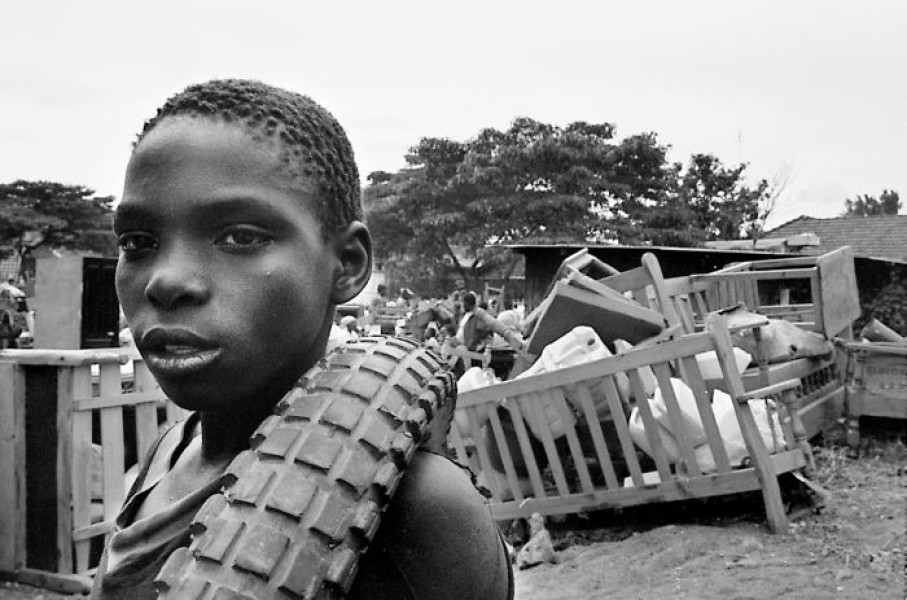
During post-election violence in 2008, residents in the city of Nakuru pack up all the possessions they can and gather at a church to seek transport out of town. (Daniel McCabe)
Current
Background: A History of Failure to Address Root Causes of Violence
Kenya’s December 2007 presidential and parliamentary elections were preceded by deep political tensions that culminated in a period of intense violence and political unrest. Allegations of electoral manipulation intersected with ethnic tension and boiled over into fighting, riots, sexual violations, and bloodshed. The post-election violence resulted in an estimated 1,100 deaths and widespread destruction and displacement.
In January 2008, the two main political parties—incumbent President Mwai Kibaki’s Party of National Unity and Raila Odinga’s Orange Democratic Movement—agreed to negotiate. Through the Kenya National Dialogue Reconciliation mediation process led by the late Dr. Kofi Annan, the two parties signed a peace pact and realized an uneasy peace. The pact, commonly referred to as the National Accord, paved the way for the establishment of a coalition government. Its four agenda items provided for the creation of the following:
- the Truth, Justice and Reconciliation Commission (TJRC) to investigate past violations,
- the Commission of Inquiry on Post-Election Violence (CIPEV, or Waki Commission),
- the Independent Review of the Elections Commission (IREC) to investigate the crisis, and
- a comprehensive constitutional review.
The Waki Commission and IREC completed their work in September and October 2008. Their recommendations, among other things, called for:
- The creation of a special tribunal to prosecute perpetrators who bore the “greatest responsibility” for the post-election violence
- Major police force reform including the merger of the Administration Police and the Kenya Police Service, and vetting of all officers
There has been partial implementation of these recommendations. A new constitution was adopted in August 2010, and some reforms were instituted, most notably in the judiciary and the police.
But the pace of reforms has been slow. The TJRC, established in 2008, handed its final report to the President in May 2013. The proposed special tribunal was never created: The bill was defeated in Parliament in February 2009. In response, in March 2010, the International Criminal Court (ICC) announced an investigation into Kenya’s postelection violence. On March 8, 2011, the ICC issued summons for six people—Mohammed Hussein Ali, Uhuru Kenyatta, Henry Kosgey, Francis Muthaura, William Ruto, and Joshua Sang—for crimes against humanity. The cases against four suspects were confirmed in January 2012, but all the cases have since been withdrawn or vacated. Two of these suspects, Kenyatta and Ruto, contested the March 2013 presidential elections and succeeded in getting elected to the two highest offices in Kenya. Kenyatta became the second sitting head of state, after Sudan’s Omar al Bashir, to face indictment by the ICC.
ICTJ's Role
- ICTJ has continuously urged Kenyan authorities to establish a credible, transparent, and accountable domestic prosecution mechanism. It supports the proposal to create a credible International Crimes Division and has provided assistance to advance the proposal. We have provided technical assistance to various local actors on documentating human rights violations and to the recently concluded criminal case involving sexual and gender-based crimes during the post-election violence.
- ICTJ provided technical assistance and observation in the vetting of the judiciary. It supports local organizations' advocacy efforts on judicial and police reform. We provide technical assistances to both relevant institutions and civil society organizations to enhance their capacity to undertake and deliver credible reforms. We have supported the development of a legal and policy framework for reform and continue to produce policy briefs for key government departments, civil society, and others with an interest in judicial and security sector reform.
- ICTJ helped Kenyans successfully lobby for amendments to the amnesty provisions in the bill establishing the TJRC. We took a lead role in successfully pressuring the TJRC’s chairperson, Ambassador Bethuel Kiplagat, to resign after serious allegations were made of his past involvement in human rights violations; when he stepped down, albeit temporarily, we offered technical support to the commission. After several extensions, the TJRC released its final report in May 2013. Although the report has not been legally adopted, its recommendations continue to be implemented incrementally. We are helping to advance the truth-seeking agenda from the ground up by building the capacity of local and victims’ organizations to lobby for the full adoption and implementation of the TJRC’s recommendations.
- ICTJ has extensively studied the reparative needs of victims of human rights violations from the 1950s to 2008. ICTJ’s 2011 report, “To Live as Other Kenyans Do: A Study of the Reparative Demands of Kenyan Victims of Human Rights Violations,” was influential and informed civil society efforts to draft the reparations framework that TJRC incorporated in its report. We have also supported and provided technical expertise to government and nongovernment actors in drafting a legal and policy framework for reparations.
