



1521 results

Four international legal and human rights groups are together urging all concerned to ensure that the current trial in Guatemala of former president Efrain Rios Montt on charges of genocide and crimes against humanity proceeds with due respect for judicial independence. The four are: the Open Society Justice Initiative, the International Center for Transitional Justice (ICTJ), the Center for Justice and International Law (CEJIL), and the Washington Office on Latin America (WOLA).

The decision of a judge in Guatemala City to send former military dictator Efraín Ríos Montt to trial on charges of genocide and war crimes is a watershed moment in the country’s complex journey towards a genuine respect for the rule of law. This genocide trial - the first genuine attempt anywhere to prosecute a former head of state in his own country on charges of genocide – has the potential to shatter a significant part of the wall of denial that surrounds Guatemala. For that to happen, the trial must be fair and free of intimidation, argues ICTJ Vice President Paul Seils in this op-ed.

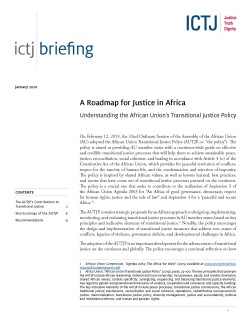
On February 12, 2019, the Assembly of the African Union adopted the African Union Transitional Justice Policy. The policy serves as a guide for member states on effective and credible transitional justice processes to achieve sustainable peace, justice, reconciliation, social cohesion...

PDF of the first page of the briefing paper "A Roadmap for Justice in Africa"

Development theory and practice to date has not engaged extensively with transitional justice. This paper explores tentative pathways to conceive of how development and transitional justice practices connect-from a development practitioner's point of view.

Youth activists in Tunisia have played a vital role in keeping corruption at the center of public debate since the country's revolution in 2011. Through decentralized, nationwide protest movements, young Tunisians have been calling for measures that root out systems of endemic corruption. ICTJ sat down with one youth leader to discuss her activism and views on Tunisia's transitional justice process.

Part of a series of practitioner-oriented publications by OHCHR, focused on the establishment and implementation of reparations programs. Download the PDF from the OHCHR website

Part of a series of practitioner-oriented publications by OHCHR, this report provides operational guidelines on the implementation of vetting programs within the broader context of institutional reform in post-conflict or post-authoritarian societies. Download the PDF from the OHCHR w...

Hybrid courts are defined as courts of mixed composition and jurisdiction, encompassing both national and international aspects, usually operating within the jurisdiction where the crimes occurred. Drawing on the lessons learned from hybrid courts created since 1999, this publication ...

This publication is intended to assist in the implementation of principles contained in international human rights documents and treaties. It is a practical tool to provide guidance on implementing reparations initiatives. Its focus is not on redressing single or isolated human rights...

This publication sets out basic considerations on prosecution initiatives. It is intended to assist United Nations field staff when advising on how to address the challenges of prosecuting perpetrators of crimes such as genocide, crimes against humanity and war crimes. It focuses on t...