1521 results

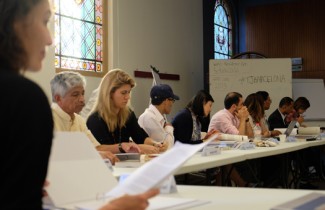
For seven years, ICTJ has partnered with the Barcelona International Peace Resource Center to provide an intensive course on truth commissions for practitioners and policymakers from around the world. The course aims to provide participants with practical knowledge that they could bring back and apply in their home countries.

Tunis, September 24, 2018—The International Center for Transitional Justice and the University of Birmingham launched Voices of Memory, an interactive exhibition inspired by a collective of nine Tunisian women from across the country and from different generations. The exhibition is the first collective testimonial of Tunisian women who experienced human rights abuses under the Ben Ali regime.

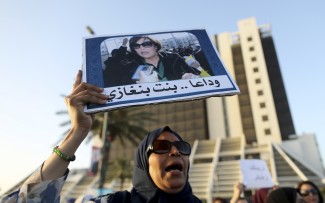
Libyan civil society organizations are fighting against all odds to support victims of human rights violations. In doing so, they themselves risk violence and do their work despite the visible and invisible pain they feel and the innumerable obstacles placed in front of them. Renewed global attention on the Libyan conflict and two new draft laws to protect activists and others may help.

“There is also the question of memory. It is necessary that all that happened becomes part of the national memory. And this will be a guarantee against the return of the dictatorship.” — Ridha Barakati, Tunisian Activist

In designing transitional justice in Armenia, policymakers, civil society activists, and international actors should remember those who have not had justice for so long: the families of those killed or injured in March 2008, the victims of torture and political detention, the mothers in black seeking the truth about why their soldier sons were killed, the old pensioners who live in cold and hunger, farmers and rural communities who need access to social services, and students and young citizens who saw that their hope for a better future required a revolution.

“Judgment Denied,” a report from the ICTJ, details four military court cases in the Democratic Republic of the Congo involving dozens of victims, egregious human rights violations, and nearly $1 million in outstanding awards owed by the government. In every case, serious crimes were committed against civilians by members of the Congolese Army, but the government has yet to pay compensation ordered by the courts.

An end could be in sight for the longest-running armed conflict in the Western Hemisphere. Peace negotiations between the government and the Revolutionary Armed Forces of Colombia (FARC) rebels have begun on 17 October in Oslo, Norway, and will continue in Havana, Cuba.

For a long time, making compromises on justice with powerful perpetrators of mass atrocities has been an integral part of peace negotiations ending conflicts. The immediate concern of ending the violence often resulted in amnesties for war crimes and crimes against humanity, sometimes even...

The two goals of peace and justice, rather than being exclusive, are mutually reinforcing. When justice is ignored, the danger of violence recurring remains high.

This report is the fourth in a series monitoring the implementation of a collective reparations program in Peru since 2007, by ICTJ and the Association for Human Rights in Peru (APRODEH). The publication examines the effects of this reparations program through interviews with the bene...