

1521 results

In this briefing paper ICTJ addresses one of the crucial points of the peace negotiations between the Government of Colombia and the Revolutionary Armed Forces of Colombia-People’s Army (FARC-EP): the possibility of providing recourse to the broadest amnesty possible and pardons as pa...

President Jacob Zuma risks irreparably damaging the credibility of core elements of South Africa's deal with the victims of apartheid with his current plan to pardon 149 serious offenders and to potentially consider another 926 applications which are before him. Such a move would mark a profound breach of trust with the victims and South African society at large.

On April 4 last year, the commander of the Libyan National Army Khalifa Haftar ordered his troops to advance on Tripoli and “liberate it from terrorists.” Various stakeholders issued a multitude of statements and joint declarations after the assault, all asserting that only a political solution would resolve Libya’s crisis and threatening to hold accountable any faction that escalated the conflict. But in reality, most of the stakeholders have been playing two fields all along: the diplomatic one, in which they continuously reiterate support for political solutions and UN-led initiatives, and then the battlefield.

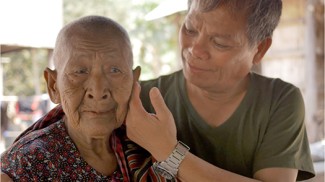
Angkar, screened on June 16 at the New York Human Rights Watch Film Festival, follows Khonsaly, a victim of the Khmer Rouge, on his journey to the village he fled almost 30 years ago. The film, produced by Neary Adeline Hay about her father's experience with torture and repression, is an intergenerational offering to truth and memorialization work that dances between the inheritance of abuse and its painful recollection by a survivor.

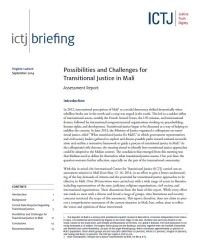
This briefing paper examines the potential in Mali for appropriate and effective transitional justice approaches that are reflective of the primary concerns and demands of citizens. Over 30 interviews were conducted with a wide range of actors in Bamako, including representatives of t...

Bosnian Serb leader Radovan Karadzic was recently sentenced by the ICTY to 40 years for genocide and crimes against humanity, crimes which have decisively shaped the society in Bosnia and Herzegovina. In this essay, ICTJ’s Refik Hodzic explores what would it take for this poisonous legacy to be dismantled and makes a case for acknowledgement and reparations as matters of moral imperative, but also of political necessity.

This paper is meant to help the Extraordinary Chambers in the Courts of Cambodia (ECCC), the civil parties before the court and other Khmer Rouge period survivors and their families deal with practical and legal issues in the course of fulfilling the reparations mandate of the ECCC. ...

To mark the launch of our new publication, "Forms of Justice: A Guide to Designing Reparations Application Forms and Registration Processes for Victims of Human Rights Violations", we sat down with Jairo Rivas about his work in designing reparations forms in Peru and Colombia.

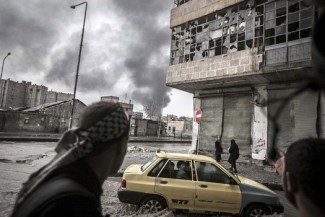
Though the future of President Bashar al-Assad’s regime remains to be seen, some are already planning for the complex aftermath of the regime’s demise. On January 26-27, Syrian activists joined ICTJ and other international experts in Istanbul for two days of discussion on possibilities for transitional justice in Syria.

The internationally acclaimed documentary “The Silence of Others" about the forgotten victims of Franco's fascist dictatorship in Spain brings much-needed attention to the right to the truth.