
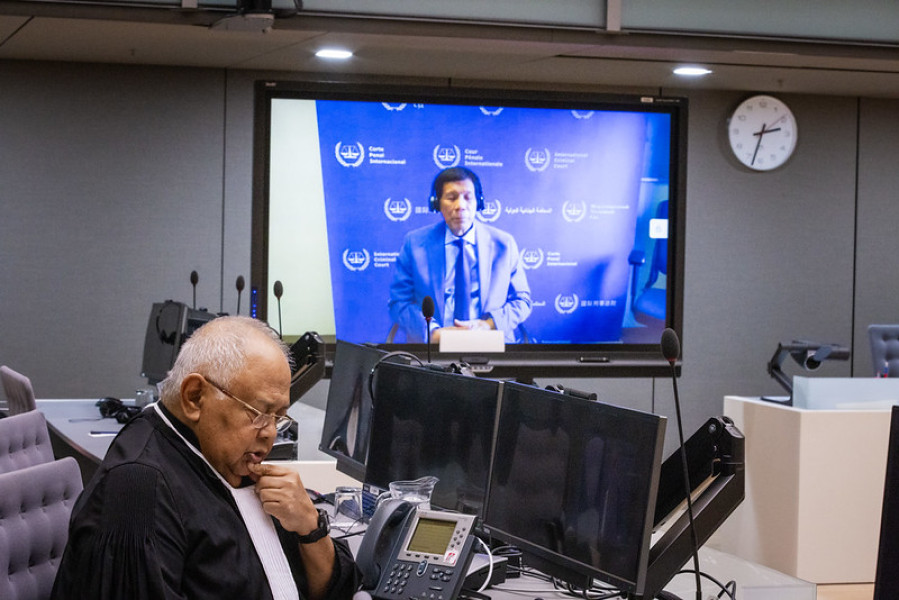

A few months ago, I addressed an audience at Georgetown University’s campus in Doha, Qatar. The university had invited me to speak about the International Criminal Court (ICC) case against former Philippines President Rodrigo Duterte and what it means for Filipino victims of his drug war and its broader implications in a world where the pursuit of justice and accountability is becoming more difficult. The group of mostly students and faculty was joined by a large contingent of overseas Filipino workers (OFWs). In Qatar alone, there are about 250,000 Filipino workers.
The first slide of my presentation featured a photo of pro-Duterte Filipinos in Qatar who had organized a “bring him home” rally for the detained ex-president. Local authorities later arrested some of these demonstrators for their unsanctioned political event. “Who among you were there?,” I playfully asked the audience. The OFWs laughed. A few responded in Filipino: “Wala. Hindi kami DDS!” (“Not us. We are not DDS!”) For them, “DDS” stands for “diehard Duterte supporters.” However, in the criminal case against Duterte, the ICC uses the same abbreviation to refer to the “Davao Death Squad,” a vigilante group that summarily executed street children and other individuals suspected of petty crimes and drug dealing in Davao City during Duterte’s tenure as mayor there.
That DDS can have those two meanings—one that sounds like a Duterte fan club and the other denoting his gang of mass murderers—shows how fanaticism fed by lies and by the dehumanization of others can unleash the slaughter of mostly poor and powerless people. It happened in the Philippines. It is happening in Gaza. It is happening slowly in an increasingly authoritarian United States. Perpetrators target families. They disrespect homes. They destroy communities. They murder anyone—or everyone, even children.
In my talk, I emphasized a lesson learned from transitional justice experiences: that punishment alone, whether it is for crimes against humanity or genocide, will almost always fall short in delivering justice when the magnitude of loss and suffering is exceptionally profound. In these circumstances, truth telling, reparations, and memorialization may be necessary if not more meaningful forms of justice.
I noted that, while current President Ferdinand Marcos Jr., the late dictator’s son, handed Duterte over to the ICC, he has rejected any notion that the Philippines should rejoin the Rome Statute. He has also refused to back a proposal to establish a truth commission for the crimes perpetrated during Duterte’s yearslong “war on drugs” campaign. There is no official memorial to the victims of the campaign. And in the same way that Marcos Jr. has never acknowledged the human rights violations committed by his dictator-father, he has never questioned the extrajudicial killings carried out under Duterte’s command.
In the end, Marcos Jr.’s willingness to have Duterte tried at the ICC was never about accountability. It was about preventing a rival dynasty from returning to power, a perceived threat validated by his then-vice president, Sara Duterte, Rodrigo’s daughter and a political challenger.
I reminded the audience that the disinformation networks that the Dutertes and Marcoses have deployed in their rise or return to power are the same ones that have conditioned too many Filipinos to accept the dehumanization and murder of over 20,000 of their own people. Even if Duterte were to be convicted, it would take more than an ICC judgment to reverse the moral decay that made mass murder acceptable.
And so, to end my talk, I showed a slide with a QR code that the audience could scan. It linked to the website Paalam (“Farewell” in Filipino). The website memorializes those killed in Duterte’s war on drugs and includes their names, photos, and other important information. I asked those in the audience to navigate to the website’s search bar and enter the name “Bladen Skyler Abatayo.” It was difficult for me to ask, even to say the name out loud, because this 4-year-old boy was from my hometown in the Philippines. But I wanted them to see his name and his face—and to understand what is lost when we lose our humanity.
______
PHOTO: Former Philippines President Rodrigo Duterte first appears before the International Criminal Court’s Pre-Trial Chamber I on March 14, 2025. (ICC-CPI)

