
Colombia has embarked on an ambitious path toward peace, reconciliation, and justice for victims of the internal armed conflict, through the implementation of the comprehensive 2016 peace accord between the government and the Revolutionary Armed Forces of Colombia—People's Army (FARC-EP). ICTJ continues to contribute to these efforts by advocating for victims’ rights and providing technical advice and knowledge based on comparative experience to help secure justice for victims.
Colombia
Image
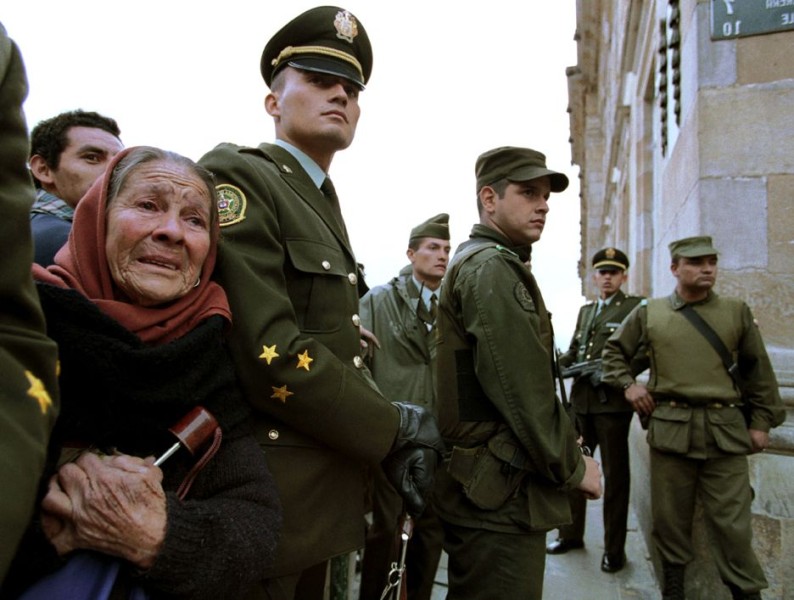
An elderly woman grieves at the funeral of an assassinated public figure in Bogota. (Scott Dalton)
Current
Background: After Decades of Conflict, Cementing Peace and Securing Justice for Victims in Colombia
Colombia is in the process of implementing a peace agreement that put an end to 50 years of internal conflict with the country’s biggest guerrilla group, the Revolutionary Armed Forces of Colombia—People's Army (FARC-EP). The peace negotiations positioned the rights of the conflict’s victims to accountability, truth and reparation at the center of the political life of the country. Victims have played an important role in Colombian politics at various points throughout the decades of conflict, and accountability for crimes committed by non-state and state armed forces remains a contentious and politically charged issue. However, the comprehensive peace accord represents Colombia’s most holistic, wide-ranging effort to address the root causes of conflict and fulfill victims’ rights.
The armed conflict has involved many actors and interests, and it is the product of political ambitions, social and economic tensions, and competition for resources. Numerous factors contributed to the evolution and degradation of the conflict, including the persistence of agrarian issues (such as the concentration of land ownership, the rural-urban gap, and inequality), the emergence and proliferation of drug trafficking, limited political participation, and the lack of state presence and services in the regions most affected by the armed conflict.
Guerrilla groups emerged during the 1960s out of peasant and communist uprisings against the state. Starting in the 1980s, right-wing paramilitary groups formed with the complicity of public officials, comprised mainly of landowners who wanted to protect themselves from guerrilla groups, adding another dimension to the conflict. Drug trafficking also contributed significantly to the escalation of the conflict, becoming one of the main factors fueling the conflict.
Armed groups on all sides sought to reduce the military capacity of their adversaries and control the civilian population by committing horrendous crimes. Mass violence created more than nine million victims over the span of 50 years—roughly 18 percent of the country’s population. According to the 2012 report of the National Center for Historical Memory, the conflict has resulted in:
- 220,000 people killed
- Nearly 6 million people displaced
- Over 60,600 cases of forced disappearances, sexual crimes, and gender-based violence
- The forced recruitment of almost 6,500 children and youth
The Peace Agreement and Current Challenges
After 50 years of violence and more than 220,000 deaths, the Colombian government and the FARC-EP guerrillas signed a peace agreement to end the western hemisphere’s longest-running conflict. The final agreement, which includes the Comprehensive System of Truth, Justice, Reparation and Non-Recurrence, was signed in September 2016 and submitted for public approval via plebiscite in early October 2016. Unexpectedly, the plebiscite voted against the agreement by a narrow margin (50.2 percent against, 49.8 percent in favor), leading to further negotiations between government and FARC-EP representatives and a revision of some of the terms of the peace agreement. Although the revised agreement was signed by all parties and approved by the Colombian Congress, the initial resistance and mistrust of half of the population have further polarized the country around notions of peace, justice, and security.
The negotiations in Havana were informed by public consultation and discussion through a number of mechanisms, including regional forums and “peace roundtables,” allowing civil society, victims, social groups and others to present thousands of proposals to inform the contents of the final accord. Over 60 victims of violations committed by both sides of the conflict traveled to Havana to testify about their experience and present proposals to the negotiating parties. Of those, 60 percent were women.
The final agreement contains the results of four years of negotiation on six points: agrarian reform, political participation, illicit drugs, victims, ending the conflict, and implementation of the peace accord. The agreement on victims provides for a number of mechanisms meant to provide accountability for serious crimes and fulfill the rights of victims to truth, justice, reparation, and guarantees of non-recurrence. These new institutions (the Special Jurisdiction for Peace, a truth commission, and a unit to search for people disappeared during the conflict) have made significant progress since beginning operations in 2017. However, they continue to face opposition from some society and political sectors. The increase in violence in some regions and the elections in 2022 create new challenges that must be overcome to ensure the fulfillment of victims’ rights. The escalation in violence, including killings of social leaders and former FARC guerrillas, is also affecting the reintegration process and the political and social participation of FARC members.
Previous Accountability, Acknowledgment, and Redress Efforts
The recent comprehensive peace accord is the culmination of decades of peace negotiations, demobilization of combatants, and the search for truth, justice, and reparations for victims. The peace process continues even after the agreement with FARC-EP, with ongoing negotiations with the other major armed group still in combat with government forces, the National Liberation Army (ELN).
Between 2003 and 2006, a political pact initiated by former President Alvaro Uribe led to the demobilization of more than 35,000 members of the paramilitary group United Self-Defense Forces of Colombia (AUC), according to government figures.
In 2005, Law 975, known as the Justice and Peace Law, was enacted to facilitate the reintegration of these demobilized former combatants into civilian life. This law offered former paramilitaries reduced prison sentences in exchange for their full confession and contribution to reparations for victims and national peace. By October 2020, over 4,400 former paramilitaries had passed through the justice and peace tribunals, but only 650 had been sentenced. While the process was seen to be falling short in holding all perpetrators accountable and establishing the complete truth about the paramilitary phenomenon, it did create an enabling environment for victims’ organizations and their advocacy efforts in the areas of truth, justice, and reparations. Unfortunately, many former paramilitary groups have re-emerged as criminal gangs and are currently threatening the implementation of the peace accord in the regions.
In 2011, the administration of President Juan Manuel Santos promoted the passage of Law 1448, known as the Victims’ Law, which established a comprehensive reparations program, truth-seeking mechanisms, and land restitution procedures for victims of the armed conflict. The government created new institutions to implement these programs, namely the Victims’ Unit, the Land Restitution Unit, and the National Center for Historical Memory.
To date, these initiatives have provided some measure of justice to some victims, but their effectiveness was reduced because of the ongoing conflict: It proved difficult for them to address violations committed during the conflict while the conflict persisted. With the peace agreement in place, these institutions will continue their work in a new context that may create more opportunities for impact.
ICTJ's Role
ICTJ has worked in Colombia since 2005, supporting the work of civil society organizations, providing technical assistance and training, influencing national transitional justice policies through advocacy and political dialogue, and broadening understanding of the development of transitional justice in the country through outreach and communications strategies.
- Building capacity. ICTJ provides technical assistance to the Special Jurisdiction for Peace, the truth commission, and the search unit and other national institutions that advance justice for victims, including the Attorney General’s Office and the justice and peace tribunals. This has included technical reports to inform key processes. ICTJ also supports civil society organizations in Bogota and the regions, including victims’ and women’s organizations, providing training, dialogue, and assistance for the presentation of reports on serious crimes to the transitional justice institutions and for their participation in these mechanisms.
- Convening state actors and civil society. ICTJ opens spaces for interaction between active social forces and institutions, including the transitional justice mechanisms, providing not only victims but other groups the opportunity to voice their concerns and discuss solutions to advance victims’ rights. ICTJ expertise and comparative international experiences have served to enrich these discussions.
- Increasing public engagement and understanding. ICTJ is helping to improve the public’s understanding of the transitional justice mechanisms by producing online content that informs the debate in Colombia, promoting art and cultural youth initiatives on truth and memory, and supporting processes of acknowledgment of responsibility to advance restorative justice. Greater civil society engagement will help increase the legitimacy of the transitional justice institutions and advance reconciliation by fostering respect for those who think differently.
- Advancing women’s and LGBT rights. Colombia has a strong women’s movement, which ICTJ has recognized and supported in different spaces for discussion of proposals for the implementation of the transitional justice mechanisms established in the peace agreement. ICTJ incorporates a gender-sensitive, gender-responsive approach in all its work. In Colombia, ICTJ strengthens the capacity of women leaders and ensures women’s voices are included in local truth and memory processes. ICTJ also supports the development of novel approaches, such as the report on conflict-related violations against LGBT victims.
- Conducting research and sharing knowledge. ICTJ produces and distributes expert publications on transitional justice based on research conducted both in Colombia and internationally. These documents include recommendations that contribute to the implementation of transitional justice mechanisms, such as a report on retributive and restorative justice in the Special Jurisdiction for Peace.
