Latest News

Explore our feature stories, opinion articles, and press releases.

ICTJ's documentary Voices of Dignity inspired Wilson Herrera, professor of philosophy and researcher at the Universidad del Rosario in Colombia, to reflect on the role of victims in a democratic society, and on the importance of empowering them as agents of change and rights-holders, rather than relegating them to the status of permanent victims.

ICTJ welcomes the 6th National Event of Canada's Truth and Reconciliation Commission, part of the TRC’s journey towards completion of its mandate: to learn the truth about what happened in the residential schools, and to inform all Canadians about this history.

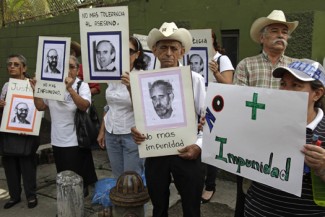
Enforced disappearances are among the cruelest of crimes. To the kidnapping, torture, and in many cases, murder of the victim, perpetrators intentionally create fear and uncertainty about the fate of the missing person. Although men are predominantly targeted, the impact on women is severe and lasting.

In the brutality of armed conflict or tyranny of a repressive regime, many who go missing are never found again: whether “disappeared” by agents of the state or abducted by an armed faction, the whereabouts of thousands are still unknown to this day. On this International Day of the Disappeared, ICTJ recognizes that enforced disappearances constitute crimes against humanity, and they affect women in ways unique from the impact on men.
Ten years ago, on August 28, 2003, the Truth and Reconciliation Commission (TRC) of Peru presented its final report, clarifying the grave human rights violations committed between 1980 and 2000 during the internal armed conflict and the regime headed by Alberto Fujimori. This month, ICTJ joins Peru to examine the legacy and impact of the TRC.

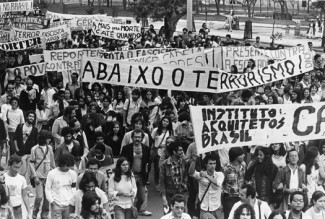
Human rights organizations in Brazil have created an online platform Brasil Nunca Mais Digital to preserve evidence and other documents related to more than 7,000 political prisoners tried before Brazil’s Military Supreme Court, during that country’s military dictatorship.

Children and youth are especially vulnerable to the effects of conflict and gross human rights violations. In this edition of the ICTJ Program Report, ICTJ's Children and Youth Program Director Virginie Ladisch talks with us about the importance of integrating child and youth sensitivity into transitional justice mechanisms.

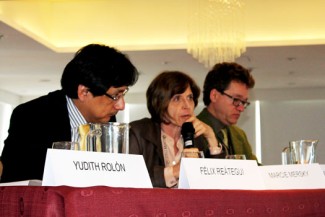
The one-day forum “Latin American Experiences with Truth Commissions,” organized by the International Center for Transitional Justice in Bogotá on July 22, brought together leading experts to discuss experiences and lessons learned from truth-seeking processes that shed light on massive human rights violations in four countries: Argentina, Guatemala, Paraguay, and Peru.

Thousands of victims of Peru’s internal conflict are still awaiting compensation and benefits as part of a 2005 national reparations plan, says a report released today by ICTJ. “Reparations in Peru: From Recommendations to Implementation,” looks at the government of Peru’s mixed record of providing compensation to individuals and communities that suffered some of the most serious crimes during the conflict.

Media play an essential role in peace negotiations and post-conflict situations. In the highly polarized and politicized context of Colombia, the Gabriel García Márquez Foundation for New Ibero-American Journalism (FNPI) chose May 3, Worldwide Freedom of Expression Day, to bring together directors and editors of Colombia’s main news media to reflect on their role at a historic moment for the country: the government’s peace talks with the FARC, which represent a possible end to five decades of armed conflict.