Latest News

Explore our feature stories, opinion articles, and press releases.

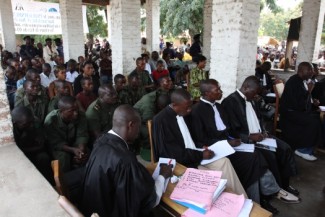
ICTJ, in cooperation with the United Nations Joint Human Rights Office (UNJHRO) and the United Nations Development Programme (UNDP), organized a high-level conference in Kinshasa today to discuss ways to strengthen the Congolese judicial system and its ability to investigate and prosecute serious crimes, such as genocide, war crimes, and crimes against humanity.

Kenya continues to deal with the repercussions of violence stemming from its disputed 2007 presidential elections, when political protests and targeted ethnic violence rocked the country, leaving thousands dead and hundreds of thousands displaced. Head of our Kenya office Chris Gitari gives an update on how Kenya is moving forward, and explains ICTJ's work in the country.

ICTJ convenes a high-level conference in Abidjan to discuss the progress in investigating and prosecuting serious crimes committed in Cote d’Ivoire during the 2010 post-election violence.

Lebanon should take firm steps to provide redress to victims of past conflicts and help prevent future violence, ICTJ and Lebanese rights groups said today at a roundtable discussion in Beirut. Lebanese authorities have mostly failed in their responsibility to end ongoing violations and ensure justice and truth for victims of the 1975-1990 war and successive conflicts.
In this op-ed, ICTJ's Refik Hodzic says that five years of a trial, thousands of documents and evidence exhibits, hundreds of witnesses, and hours testimony have not moved Radovan Karadzic closer to acknowledgement of the suffering he inflicted on countless lives.
A new report from the United Nations Special Rapporteur on the promotion of truth, justice, reparation and guarantees of non-recurrence says States should hold perpetrators of serious crimes accountable for their actions.

In this interview, Judge Walid Melki explains how Tunisia's Specialized Judicial Chambers will investigate and prosecute serious human rights violations.

On the International Day of the Disappeared, ICTJ Vice President Paul Seils argues that addressing the legacy of forced disappearances is both a moral imperative and a pragmatic necessity.

On August 7, the Extraordinary Chambers in the Courts of Cambodia (ECCC) found two senior leaders of the Khmer Rouge, Nuon Chea and Khieu Samphan, guilty of crimes against humanity. For many victims who have been waiting for 35 years, the judgment still felt like bittersweet justice.

By this summer, dozens of paramilitaries and guerrillas in Colombia's Justice and Peace process will have already spent eight years in prison. In accordance with the law, those who fulfill their obligations to contribute to the truth and provide reparation to victims should be released after serving eight years. In this op-ed, ICTJ's Maria Camila Moreno analyzes the valuable lessons learned through this process.