

743 results

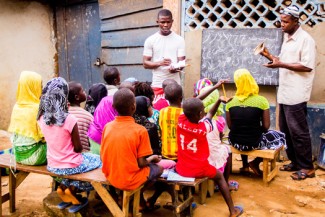
Children are particularly affected by conflict and mass atrocities and have a unique perspective on how those events impact their communities. This makes their participation in transitional justice processes essential for countries to genuinely make a break with the past and successfully address legacies of mass violence.

This report, part of a joint research project by ICTJ and UNICEF on the intersections of education, transitional justice, and peacebuilding, explores how a transitional justice framework can help to identify educational deficits relating to the logic of past conflict and/or repression...

In this op-ed, ICTJ President David Tolbert argues that President Alassane Ouattara should use his second term as president to address widespread atrocities committed in Cote d'Ivoire's recent past.

Sri Lanka may be undertaking a change of course towards accountability for atrocities committed during its 26-year civil war.

In commemoration of the 25th anniversary of the end of the Lebanese civil war, ICTJ is holding a youth photo contest to raise awareness about the importance of truth seeking and truth telling about people’s experiences of the war and post-war violence.

ICTJ welcomes the recent agreement announced by the Government of Colombia and the Revolutionary Armed Forces of Colombia (FARC) to commit to immediately implement measures to search for, locate, and identify those who have disappeared during the 50-year armed conflict and – if a final peace agreement is reached – to create a special unit dedicated to these tasks.

In this op-ed, Rim El Gantri, head of ICTJ's Tunisian office, discusses the challenges facing Tunisia's transitional justice process and argues that the government's failure to provide accountability for crimes committed under past regimes threatens the country's transition to democracy.

ICTJ welcomes the award of the 2015 Nobel Peace Prize to Tunisia's National Dialogue Quartet for helping the country transition to democracy. With the award, the Nobel committee acknowledges the "decisive contribution" made by the group of civil society organizations after Tunisia’s 2011 revolution.

Tunisia continues to take steps to fulfill its commitments under its ground-breaking Transitional Justice Law and realize the goals of the 2011 revolution. But a rocky start to the country’s new truth commission and proposed reconciliation-cum-amnesty legislation could undermine these efforts, according to a new paper by ICTJ.

After toppling Hosni Mubarak’s dictatorship in February 2011, Egyptians were eager for a reckoning with past injustices. But after years of political turmoil, the possibility of a genuine transitional justice process in Egypt is uncertain. We turned to three leading Egyptian activists to examine if there really is a chance for justice and reform in Egypt in the near future.