

643 results

To offer assistance and international expertise to Tunisian civil society groups, ICTJ partnered with the Office of the High Commissioner for Human Rights (OHCHR) for a training on public engagement in truth seeking processes. Titled “The Role of Civil Society in Truth Commissions: Participation and Advocacy for Victims in Tunisia,” the training offered around 65 participants the opportunity to examine the role of truth commissions in contexts of transitional justice, and to assess future engagement of their organizations in Tunisia’s proposed truth commission.

On December 17th, six years to the day after Mohamed Bouazizi set fire to himself and sparked the “Jasmine Revolution,” Tunisia’s Truth and Dignity Commission heard public testimony about events that unfolded during the revolution and the abuses of the regime it overthrew. Read victims' moving testimony about state violence, torture, corruption and marginalization as the country continues to grapple with its painful past.

On the International Day for the Right to Truth we spotlight one of the most powerful ways truth commissions can reassert victims' dignity: public hearings. These open events can have a potentially cathartic power for victims and their families, but also the public at large by generating solidarity and empathy for the suffering of others in societies deeply polarized and traumatized by atrocities and denial.

The ICTJ continues to support human rights victims in Nepal in their pursuit of justice, truth, reparations, and institutional reform. This briefing paper presents a summary of findings and recommendations from workshops that ICTJ conducted with women victims, as well as meetings it h...

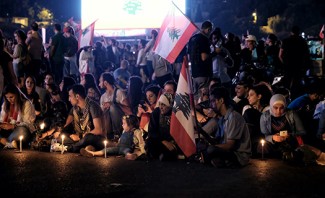
For over a month now, Lebanese people have been in the streets peacefully calling for an end to corruption, economic disenfranchisement, and government mismanagement, calling instead for accountability and reform of the systems that have allowed these things to occur. The protests are historic for several reasons: their scope and magnitude, as well as the way they have unified a country that has for so long had division baked into nearly every aspect of life, down to its system of governance.

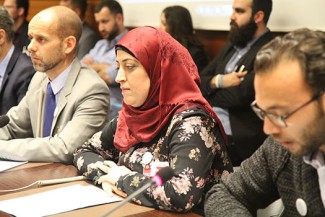
On March 22 in Geneva, we listened to the experiences of Syrians affected by attacks on schools. The Save Syrian Schools project presented the results of its one-year-long research—an unprecedented collaboration of 10 Syrian human rights organizations and the ICTJ.

Côte d’Ivoire is obligated to provide reparations to victims of both the political violence that shook the country following the 2010 presidential elections and the different episodes of political violence and armed conflict since 1990. Fulfilling this obligation will show that the st...

Myanmar may have a new government under Aung San Suu Kyi, but former political prisoners continue to face challenges throughout the country. A new report sheds light on prisoners' challenges and recommends steps the government can take to offer redress.

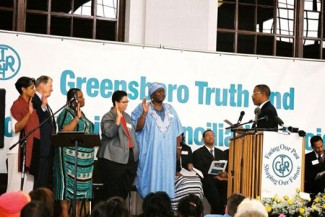
To mark 15 years of ICTJ, we asked staff past and present for the memories that stand out from their work. Former ICTJ consultant and Executive Director of the Truth and Reconciliation Commission in Greensboro, North Carolina Jill Williams reflects on her efforts to bridge a cultural gap in the pursuit of shared values.

To mark 15 years of ICTJ, we asked staff past and present for memories that stand out to them - moments that throw the stakes of our work into sharp relief and resonate with them years later. Cristián Correa, Senior Associate in ICTJ’s Reparative Justice Program, shares a story about a Chilean mother's thirst to tell her daughter the truth about their past.