

523 results

The International Center for Transitional Justice (ICTJ) signed a cooperation agreement with the Tunisian government on January 16 to provide further technical assistance in establishing transitional justice mechanisms in the country. The development comes two years after protests forced President Zine El Abidine Ben Ali to step down and flee the country in January 2011.

The latest ICTJ Program Report presents ICTJ’s work in Africa. In a deeply insightful interview, Suliman Baldo, director of ICTJ’s Africa program and one of the world’s leading experts on transitional justice in Africa, discusses transitional justice processes in Ivory Coast, Kenya, Democratic Republic of Congo, and Uganda.

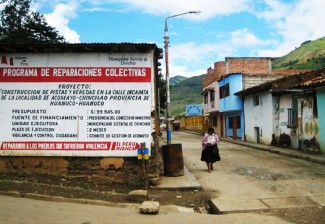
In times of transition, reparations can make a tangible impact on the everyday lives of victims. As part of a larger process of social change, reparations programs should be part of an integrated approach to addressing the fundamental rights of victims, not just their immediate needs. In this way, reparations programs have the potential to be transformative. It was this potential that was considered at a recent international seminar, "Transformative Reparation for Women Victims of Armed Conflict," held in Colombia, on November 16, 2012.

Where states commit widespread and systematic crimes against their citizens, or fail to seriously try to prevent them, they have a legal obligation to acknowledge and address the suffering of victims. Reparations, both symbolic and material, publicly affirm that victims are entitled to redress. Through video and three photogalleries, ICTJ’s multimedia project Voices of Dignity tells the story of two courageous women from Colombia, and their struggle for acknowledgement and redress in a country where more than four million people have been affected by decades of civil war.

An end could be in sight for the longest-running armed conflict in the Western Hemisphere. Peace negotiations between the government and the Revolutionary Armed Forces of Colombia (FARC) rebels have begun on 17 October in Oslo, Norway, and will continue in Havana, Cuba.

The International Center for Transitional Justice strongly welcomes the decision of the UK High Court ordering the British government to pay damages to a group of Kenyans who were imprisoned and tortured by colonial authorities following the Mau Mau Rebellion of the 1950s.

Six years after a peace agreement formally ended the conflict in Nepal, the slow, painstaking process of building the country’s new democracy has yet to provide comprehensive reparation to victims. To fully acknowledge the experience of victims of the conflict, Nepal’s government should not mistake the issuance of relief through material benefits for the implementation of a comprehensive reparation program. This is one of the central recommendations of "Relief, Reparations, and the Root Causes of Conflict in Nepal," a major new report from ICTJ, and authored by Ruben Carranza.

The report examines the measures taken in Nepal to redress victims following the 2006 peace agreement, which formally ended the ten-year civil war between the government and Maoist rebels. It looks closely at the Interim Relief Program (IRP) — a compensation scheme instituted in 2008 ...

The latest ICTJ Program Report explores transitional justice issues in Colombia and charts our work in the country with the longest running armed conflict in the world. In this interview, head of ICTJ's Colombia office Maria Camila Moreno answers questions on the ongoing transitional justice mechanisms in the country, and describes ICTJ's work with the government and civil society groups on issues of criminal justice, reparations and memory. She provides a look ahead to the new peace negotiations between the Colombian government and the FARC, and identifies key transitional justice issues at stake for the talks.

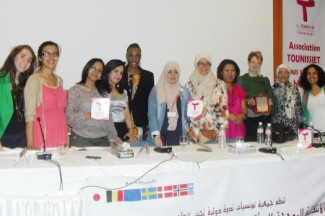
Transitional justice measures should serve to rectify, not replicate, patterns of discrimination against women. These mechanisms can challenge structural causes of gender inequality, by publicly acknowledging the factors that made such abuse possible. In the Middle East and North Africa, like in many other contexts, it is a challenge to ensure transitional justice measures do not further entrench the invisibility of gender-based abuses. As different countries consider the ways to confront the legacies of past abuses, ICTJ works with women’s groups across the region to build their capacity to engage in discussions around transitional justice and gender.