49 results

Tunis, September 24, 2018—The International Center for Transitional Justice and the University of Birmingham launched Voices of Memory, an interactive exhibition inspired by a collective of nine Tunisian women from across the country and from different generations. The exhibition is the first collective testimonial of Tunisian women who experienced human rights abuses under the Ben Ali regime.

ICTJ was pleased to host the newly elected United Nations Special Rapporteur on the promotion of truth, justice, reparations, and guarantees of non-recurrence, Fabian Salvioli (Argentina), at its New York office, where he discussed his vision and priorities.

ICTJ announces the departure of David Tolbert, President of the ICTJ, after eight years of service. David Tolbert was appointed president of ICTJ in March of 2010. He led the center’s evolution as it continued to pursue justice around the globe in changing times. ICTJ’s Executive Director, Fernando Travesi, will assume leadership of ICTJ following Tolbert’s departure at the end of March 2018.

Sixteen practitioners participated in the Intensive Course on Transitional Justice and Peace Processes held in New York from March 5 to March 9, 2018. Participants included leaders in their respective fields, including human rights law, community justice and legal services, peacebuilding, education, and humanitarian affairs. Selected course presentations, led by ICTJ experts and other specialists in the field, delved into cases of current, recent, and paradigmatic peace processes and questions of justice within a comparative context.

In the aftermath of massive human rights violations, the voices of young people carry enormous potential: they can tell the truth about the past while offering new paths forward as their societies pursue peace and justice. However, if institutions want the insights of young people, they must avoid pre-formulated solutions and instead engage with youth on their own terms. A new guide released by ICTJ today aims to provide the tools necessary to do so, offering recommendations about how to responsibly and effectively gather statements from young people.

A new ICTJ report argues that discussions about a future return of refugees and coexistence among groups currently at war in Syria must begin now, even in the face of ongoing violence and displacement.

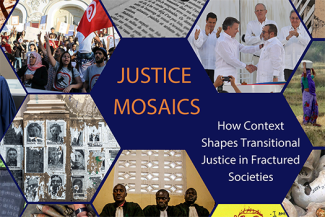
A new book by ICTJ titled Justice Mosaics: How Context Shapes Transitional Justice in Fractured Societies examines the challenges of responding to massive human rights violations in different and difficult circumstances in today's world.

A new briefing paper from the International Center for Transitional Justice provides guidance for national courts issuing decisions on redress of human rights violations involving sexual violence. It encourages judges, advocates and prosecutors to consider the full range of possible forms of redress when ordering reparations for victims, to make use of relevant national and international decisions in interpreting domestic laws, and to pay particular attention to how sexual violence may affect different victims.

Evelyn Amony tells the harrowing story of her years in captivity with the LRA, and experience of grinding poverty and stigma after returning home with two children, in her new memoir, I Am Evelyn Amony: Reclaiming my Life from the Lord's Resistance Army. The autobiography, which tells the difficult truths of women and girls in wartime as only a firsthand witness can, will be launched today in New York, at the Japan Society.

Today, ICTJ opened a two-day conference in Kampala, Uganda, gathering activists and officials from the African Great Lakes Region to discuss efforts at redress and accountability for serious human rights violations committed in their countries.