

699 results

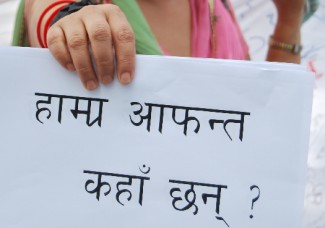
As attested by the arrest on January 3, 2013 in the United Kingdom of Kumar Lama, a Nepali Army Colonel suspected of torture, the government of Nepal’s failure to pursue truth and accountability for conflict-era violations can have serious consequences. Rather than resisting UK efforts to implement its obligations under international law, the Nepali government should develop a full transitional justice programme and redouble its efforts to provide truth, justice and reparations inside the country.

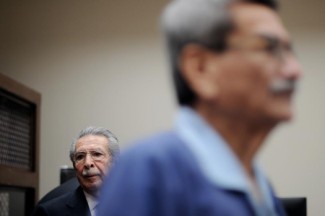
In January 2012, Guatemalan General Ríos Montt was formally charged with genocide for ordering massacres during the genocide in Guatemala. Only a year later, justice for victims has come under threat: Guatemalans and the international community are gravely concerned that the Constitutional Court could be pressured into granting amnesty. On Thursday, December 20, ICTJ joined colleagues and partners in the field to send a strong message to Guatemala: architects of atrocity must be held to account.

In Guatemala, it has taken years of relentless organizing by civil society and cooperation with international partners to begin to prosecute the most responsible, but progress has been made. Claudia Paz y Paz Bailey, currently the prosecutor general and head of the Public Prosecutor’s Office, has played an instrumental role in the struggle for accountability. In this recent interview, ICTJ spoke with Ms. Paz about confronting the legacy of the past at the national level within an international system of global criminal justice.

The United Nations has proclaimed December 10 as International Human Rights Day. The date commemorates the signing of the Universal Declaration of Human Rights in 1948, which represented the reaction of the international community to the horrors of the Second World War. Today is a day for reflection more than celebration. A cursory scan of events from the last few weeks has thrown up examples that demonstrate that the belief in human rights for all - in treating all states the same - is more of a tissue-thin membrane than a robust bulwark.

The latest ICTJ Program Report presents ICTJ’s work in Africa. In a deeply insightful interview, Suliman Baldo, director of ICTJ’s Africa program and one of the world’s leading experts on transitional justice in Africa, discusses transitional justice processes in Ivory Coast, Kenya, Democratic Republic of Congo, and Uganda.

ICTJ partnered with the Center for Global Affairs at New York University to explore how political will of international and national actors impacts national war crimes proceedings. The panel examined four diverse country scenarios - the Democratic Republic of the Congo, Serbia, Iraq, and Guatemala.

The International Center for Transitional Justice (ICTJ), in cooperation with the United Nations Development Programme (UNDP), with support from the Governments of Denmark and South Africa, and in close consultation with the Assembly of States Parties to the Rome Statute (ASP), held a...

This report, produced jointly by ICTJ's Research Unit and the Children and Youth Program, is based on a comparative review of current and past efforts to reach out to children and youth as part of outreach programming for TJ measures. Drawing from the experiences of places as varied a...

On International Children’s Day, ICTJ reaffirms the importance of an active role of children and youth in transitional justice processes, such as truth-seeking, criminal accountability, and reparations programs. In the aftermath of societal upheaval, the voices of children and youth are often absent from peace negotiations and subsequent transitional processes. Though children and youth must be able to receive adequate care and necessary rehabilitation, they must not be regarded only as victims of massive human rights abuses: they are rights-bearing members of a society trying to confront the past, and active participants in the process of social change aiming for a new future. It is in the best interest of children and youth, as well as the societies in which they live, to participate in transitional justice processes, devised to reestablish rule of law and civic trust in the societies to which they belong.

As the work of the Special Court for Sierra Leone draws to a close, we take stock of the historic milestones it has passed since its creation in advancing transitional justice through a special multimedia project, “ Exploring the Legacy of the Special Court for Sierra Leone.” This website will support two conferences: one in New York on November 7-8, 2012, and one in Freetown on January 9-10, 2013. The website will be regularly updated to provide information on the history of the court and its legacy through interactive multimedia and other features.