


605 results

New York, January 21, 2022—ICTJ will host an online course, entitled “Prevention and Guarantees of Non-Recurrence: The Role of Transitional Justice,” from March 14 through 18, 2022. Prevention has emerged as a top priority on international policy agendas for sustainable peace and development and global governance, and understanding the preventive capacity of transitional justice is more imperative than ever.

ICTJ hosts human rights scholar Michael Ignatieff and UN High Commissioner for Human Rights Zeid Ra'ad Al Hussein for an online debate whether the international community is abandoning the fight against impunity.

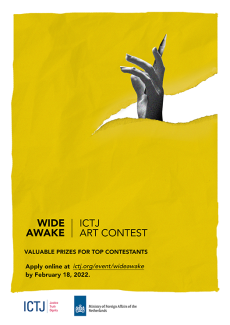
New York, January 18, 2022— The International Center for Transitional Justice (ICTJ) is pleased to announce the “Wide Awake Art Contest,” an open call to Lebanese and Tunisian artists as well as artists living in Lebanon or Tunisia to explore the theme “the Sound of Dissent.” The contest will showcase works by those who are documenting and memorializing their communities’ stories in times of instability, resistance, and change.

ICTJ has formally accepted the invitation to participate in Colombia’s Selection Committee, reflecting its commitment to work for peace and victims’ rights in that country. It has not yet selected its delegate, contrary to prior reports.

ICTJ has announced the digital release of its award-winning short animated documentary that explores the trauma and resilience of families of the disappeared in Syria. After an extensive tour of international film festivals in Asia, Europe, and North America, the acclaimed film recently returned home for its first screening in Syria. Now, it is available to audiences the world over on the ICTJ website and YouTube channel.

On February 4, 2021, the prominent activist, intellectual, writer, and filmmaker Lokman Slim joined the long list of victims of violence and impunity in Lebanon. The courageous human rights and political activist was found shot to death in his car in southern Lebanon.

Eminent human rights defender José Zalaquett passed away on February 15. “Pepe,” as he was known by many, helped pioneer the field of transitional justice and inspired countless human rights defenders around the globe.

Accountability for violations against children in armed conflict is best achieved through a comprehensive approach to justice that addresses the responsibility of perpetrators and the rights of victims within a broader process of social change. This is the key message to be delivered by the International Center for Transitional Justice (ICTJ) on September 19, 2012, during the UN Security Council’s Open Debate on Children and Armed Conflict.

Eastern DRC continues to be affected by conflict and serious crimes continue to be committed against civilians living in the area by the national army (FARDC), national armed groups, and foreign armed forces. Holding perpetrators accountable is essential to dismantling the structures that allow the ongoing cycle of abuses to continue in the DRC.

The International Center for Transitional Justice today repeated the call for the withdrawal of the revamped “Economic Reconciliation” Draft Law. As one of the key expert organizations that has supported the transitional process in Tunisia since its inception, ICTJ has opposed the flawed “Economic Reconciliation” Draft Law since it was first presented in 2015, because its provisions undermine key goals of transitional justice: accountability, truth and reform.