

594 results

It has been nearly seven years since the passage of the Justice and Peace Law (JPL) in Colombia. The process continues today amidst controversies and important reflections on the direction it should take. What progress has been made and what are the shortcomings of how the law has been implemented?

Colombia continues to endure a complex conflict spanning more than four decades that has resulted in almost 400,000 registered victims and has displaced more than three million people. In a podcast with ICTJ’s vice president Paul Seils, we explore the concepts of prioritization and selection of cases and their relevance to Colombia's Justice and Peace process.

Colombia’s Justice and Peace Law (JPL) lies at the heart of the country’s efforts to dismantle notorious paramilitary groups and provide justice to thousands of their victims. As the government seeks to reform the JPL to allow for a more effective process, ICTJ will run a series of features to provide a deeper insight into the background and successes and challenges of the law.

The conviction of Thomas Lubanga is a milestone for the international criminal justice system and may make an important contribution to the development and definition of the right to reparations in international human rights law. Accompanying a submission filed with the ICC in advance of its reparations proceedings, ICTJ has produced a briefing note examining what lessons the court can learn from the broader transitional justice field.

The conviction of Thomas Lubanga is a milestone for the international criminal justice system established by the Rome Statute, and may make an important contribution to the development and definition of the right to reparations in international human rights law. ICTJ has produced a br...

The National Conference to Launch a Dialogue on Transitional Justice in Tunisia was held on Saturday, April 14 in Tunis, initiating a process which should result in the adoption of a comprehensive law on transitional justice by the country’s National Constituent Assembly. ICTJ president David Tolbert delivered a keynote address.

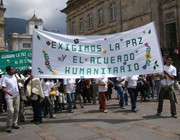
On April 9, Colombia commemorated for the first time the National Day of the Memory and Solidarity with the Victims. This photo gallery collects the expressions of commemoration that took place in three cities in the country: Bogotá, Medellín and Villavicencio.

Colombia marked the country’s first National Day of Memory and Solidarity with the Victims April 9. For the millions who have suffered human rights violations in Colombia’s entrenched armed conflict, this was a day for their voices to be heard and their suffering to be acknowledged by the state; a nationwide call for accountability and reconciliation in a highly divided society.

NEW YORK, March 22, 2011—The International Center for Transitional Justice (ICTJ) congratulates Pablo de Greiff, director of ICTJ’s Research Unit, on the nomination as the first UN Special Rapporteur on the promotion of truth, justice, reparation and guarantees of non-recurrence of serious crimes and gross violations of human rights.

In the latest ICTJ podcast, Heidy Rombouts, Kenya project leader with the German development agency GIZ, discusses how understanding the links between development, security, and transitional justice will help inform and strengthen policies for implementing complementarity on the ground. [Download](/sites/default/files/Rombouts_ICTJ_Podcast_03052012.mp3) | Duration: 11:42mins | File size: 6.69MB