


479 results

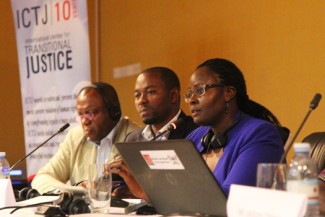
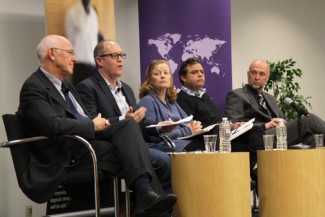
What happens when a state refuses to acknowledge the suffering of victims of mass atrocities? Or when the public celebrates perpetrators as heroes? Earlier this month, a panel discussion hosted by The International Center for Transitional Justice and New York University’s Center for Global Affairs grappled with the impact of denial on justice.

In a new briefing paper, ICTJ's Paul Seils and Roger Duthie examine what steps the international community can take during a crisis to support democracy and accountability.

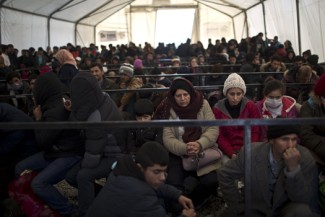
As the refugee crisis deepens, does action on transitional justice issues have to wait for peace? A new paper explores what sort of consultation and documentation work can be done now, while conflict is ongoing, to shape outcomes moving forward.

Bosnian Serb leader Radovan Karadzic was recently sentenced by the ICTY to 40 years for genocide and crimes against humanity, crimes which have decisively shaped the society in Bosnia and Herzegovina. In this essay, ICTJ’s Refik Hodzic explores what would it take for this poisonous legacy to be dismantled and makes a case for acknowledgement and reparations as matters of moral imperative, but also of political necessity.

Mali's Truth Justice and Reconciliation Commission has a mandate to examine violence dating back to 1960, but it faces serious challenges. Can it serve as a foundation of a peaceful future in Mali? We discuss with transitional justice expert Kora Andrieu, who is currently working with the TJRC as an independent consultant.

In this op-ed, ICTJ's Aileen Thomson says the concerns of former political prisoners, ethnic minorities and conflict-affected communities must be taken into account if peace and democracy in Myanmar are to endure.

The International Center for Transitional Justice (ICTJ) and the Barcelona International Peace Resource Center (BIPRC) are pleased to announce an Intensive Course on Transitional Justice and Peace Processes, taking place in Barcelona, Spain, June 6 - 10, 2016. It will focus on practical examples of recent or paradigmatic peace processes where the question of justice formed a significant part of the negotiating context.

On International Women's Day, ICTJ Gender Justice Senior Associate Amrita Kapur highlights how insecurity affects women and is key to overcoming inequality across all dimensions of empowerment. "Without including institutional reform, we are condemning women to another century of inequality," she writes in this op-ed.

Earlier this month, the International Center for Transitional Justice (ICTJ) and its partners opened a two-week photo exhibit at the American University of Beirut’s Jafet Library, featuring vivid and often deeply personal photographs submitted for its “The War As I See It” youth photo contest. Students, professors, experts, and journalists packed into the library space lined with the 26 photographs in oversized frames.

A black-and-white photo of an open book pierced by a single bullet hole was chosen as the grand-prize winner of the International Center for Transitional Justice’s Youth Photo Contest, “THE WAR AS I SEE IT” in Lebanon. The photo, titled “Dominique,” was taken by Sibylle George, a 22-year-old architecture student at American University of Beirut.