58 results

NEW YORK – The Swedish International Development Cooperation Agency (Sida) has awarded the International Center for Transitional Justice (ICTJ) a grant of 40 million Swedish kronor to implement its Strategic Plan 2018-2022. During this period, ICTJ will respond to the growing demand for its services...

On November 12, 2018, Lebanon finally passed the long-awaited, landmark Law for Missing and Forcibly Disappeared Persons in Lebanon. This breakthrough development is a result of the steadfast commitment of mobilized families and years of joint advocacy efforts, lobbying, and initiatives by local and international organizations aimed at advancing the families’ cause.

The first of its kind and the culmination of three years of planning and development, Gender Modules is a comprehensive curriculum that uses case studies to illustrate topics such as gender and reparations and the prosecution of gender-based crimes. It provides concrete guidance to those seeking to implement gender-sensitive processes – informed by successes and failures in contexts around the world.

Kenyan media house Africa Uncensored has teamed up with the International Center for Transitional Justice (ICTJ) on a documentary that explores the Bulla Karatasi massacre that took place in the northern region of Garissa, Kenya, and its impact on communities in the North. The documentary will advance ICTJ’s efforts to partner with civil society on community-state dialogue initiatives, engage stakeholders around political and constitutional reforms stemming from the TJRC’s recommendations, and achieve redress for the legacy of state violence in Garissa and other communities in Northern Kenya.

ICTJ was pleased to host the newly elected United Nations Special Rapporteur on the promotion of truth, justice, reparations, and guarantees of non-recurrence, Fabian Salvioli (Argentina), at its New York office, where he discussed his vision and priorities.

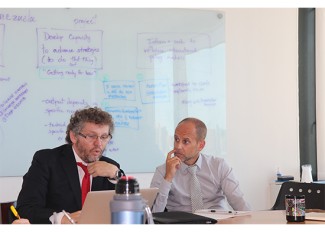
Sixteen practitioners participated in the Intensive Course on Transitional Justice and Peace Processes held in New York from March 5 to March 9, 2018. Participants included leaders in their respective fields, including human rights law, community justice and legal services, peacebuilding, education, and humanitarian affairs. Selected course presentations, led by ICTJ experts and other specialists in the field, delved into cases of current, recent, and paradigmatic peace processes and questions of justice within a comparative context.

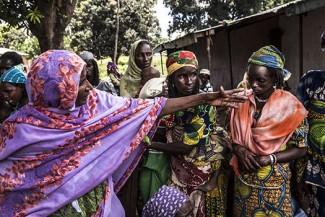
In recent months, the crisis in the Central African Republic (CAR) that erupted five years ago has seemed farther than ever from resolution. A new report by ICTJ, I Am 100% Central African: Identity and Inclusion in the Experience of Central African Muslim Refugees in Chad and Cameroon, offers important insights on how a higher political commitment to inclusion could help transform a volatile rebuilding process into a sustainable peace.

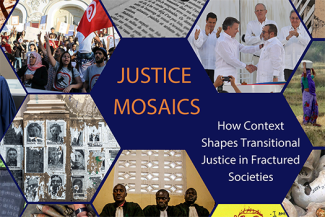
A new book by ICTJ titled Justice Mosaics: How Context Shapes Transitional Justice in Fractured Societies examines the challenges of responding to massive human rights violations in different and difficult circumstances in today's world.

A new briefing paper from the International Center for Transitional Justice provides guidance for national courts issuing decisions on redress of human rights violations involving sexual violence. It encourages judges, advocates and prosecutors to consider the full range of possible forms of redress when ordering reparations for victims, to make use of relevant national and international decisions in interpreting domestic laws, and to pay particular attention to how sexual violence may affect different victims.

A new paper from the International Center for Transitional Justice (ICTJ) offers clear, concrete proposals for a new reparations policy in Côte d’Ivoire for victims of serious human rights violations. The recommendations, informed by extensive work in the affected communities, consider a range of options, including compensation (cash payments), rehabilitation, and symbolic measures.