420 results

As the world marks August 30, the International Day of the Disappeared, we are reminded that forced disappearances and transitional justice share a common history. Indeed, processes working in concert that came to form the field of transitional justice were born from the search for truth and justice about the disappeared.

On August 9, 2012, UN Special Rapporteur on the promotion of truth, justice, reparation, and nonrecurrence Pablo de Greiff presented the first annual report to the Human Rights Council. The report provides an overview of key activities undertaken by the Special Rapporteur between May 1 and July 25, reviews the foundations of the mandate and outlines the strategy for its implementation.

The 2006 crisis in Timor-Leste saw close to 15 percent of the population displaced from their homes, threatening to sink the country into protracted instability and violence. Remarkably, five years later the country was back on track, with the internal displacement issue largely resol...

Although the conflict in Turkey remains ongoing and a political solution to the “Kurdish question” has not been reached, in recent years, the Turkish government has developed a series of laws and policies regarding the situation of displaced Kurds. The most significant of these polici...

The reparations policy for victims of Peru’s internal armed conflict, which lasted from 1980 to 2000, includes the internally displaced population among its beneficiaries under the Official Register of Victims. However, displaced persons are given lower priority than the other categor...

The ICTJ Program Report is a new online feature that presents ICTJ’s work and impact around the globe. Through monthly in-depth interviews with our experts, the ICTJ Program Report will offer a view of ICTJ’s work on reparations, criminal justice, truth and memory and other transitional justice developments in countries where we work. To launch the series, we speak with Paul Seils, ICTJ's vice president and the head of our Program Office.

In collaboration with the Brookings-LSE Project on Internal Displacement, ICTJ’s Research Unit examined how transitional justice can be used to address the range of injustices associated with displacement and thereby serve as part of a comprehensive approach to the resolution of displ...

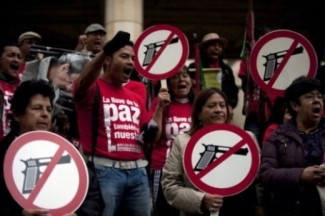
As Colombia marked International Justice Day, the importance of accountability for violations committed during the decades of conflict was underscored in the number of victims awaiting justice—376,000 registered in the Attorney General’s Office, more than 4 million in total. And while July 17 is celebrated as the date of adoption of the Rome Statute of the International Criminal Court, it is clear that in countries like Colombia accountability extends beyond criminal trials.

Following post-election violence in 2007–2008, Kenya faced a need to hold accountable those most responsible for the fighting that resulted in more than 1,000 deaths and widespread property destruction and displacement. But national judicial mechanisms proved reticent to do so, and in 2010, the situation was adopted by the ICC, who in January of 2012 announced indictments against four suspects.

Though not a state party to the Rome Statute, Cote d’Ivoire accepted the jurisdiction of the ICC through an ad hoc declaration in April 2003, and in December of 2010—in the wake of the post-election crisis—reaffirmed that declaration. It has been more than one year since Cote d’Ivoire began a critical transition from a decade-long civil war that divided the country and led to widespread human rights violations, forced displacement, and loss of civilian lives and property.

Why pursue transitional justice in the aftermath of massive human rights violations? “The Case for Justice” provides a window into the debate about the relevance of transitional justice in today’s world.

This joint report released today by the International Center for Transitional Justice (ICTJ) and the Institute for Human Rights Study and Advocacy (ELSHAM-Papua) provides important insight into the ongoing debate on steps required to achieve a sustainable peace in Papua. The report reviews Papua's recent history within a transitional justice framework, and provides expert recommendations on truth seeking, justice, reparations, institutional reform, and enforcing the rights of women victims.

This joint report by ICTJ and the Institute for Human Rights Study and Advocacy (ELSHAM-Papua) provides important insight into the ongoing debate on steps required to achieve a sustainable peace in Papua. The report reviews Papua's recent history within a transitional justice framewor...

As Yemen prepares to embark on a national dialogue about its future, addressing the legacy of the past human rights violations remains one of its key challenges. A Law on Transitional Justice and National Reconciliation has been under discussion since February 2012 and may now be adopted in the coming weeks.

Following field research in late 2009 and a 2010 workshop in Kinshasa, ICTJ produced a report in French on the challenges of enforcing court-ordered reparations. This briefing paper outlines and summarizes the challenges and recommendations discussed in the report. It also proposes ad...

With the goal of creating an opportunity for debate between civil society and the Colombian government on JPL reform, ICTJ and the Mission to Support the Peace Process from the Organization of American States have organized an event titled “Challenges and Opportunities of the Justice and Peace Law Reform,” to take place May 14 in Bogotá.

It has been nearly seven years since the passage of the Justice and Peace Law (JPL) in Colombia. The process continues today amidst controversies and important reflections on the direction it should take. What progress has been made and what are the shortcomings of how the law has been implemented?

Colombia’s Justice and Peace Law (JPL) lies at the heart of the country’s efforts to dismantle notorious paramilitary groups and provide justice to thousands of their victims. As the government seeks to reform the JPL to allow for a more effective process, ICTJ will run a series of features to provide a deeper insight into the background and successes and challenges of the law.

The conviction of Thomas Lubanga is a milestone for the international criminal justice system and may make an important contribution to the development and definition of the right to reparations in international human rights law. Accompanying a submission filed with the ICC in advance of its reparations proceedings, ICTJ has produced a briefing note examining what lessons the court can learn from the broader transitional justice field.

The conviction of Thomas Lubanga is a milestone for the international criminal justice system established by the Rome Statute, and may make an important contribution to the development and definition of the right to reparations in international human rights law. ICTJ has produced a br...

The National Conference to Launch a Dialogue on Transitional Justice in Tunisia was held on Saturday, April 14 in Tunis, initiating a process which should result in the adoption of a comprehensive law on transitional justice by the country’s National Constituent Assembly. ICTJ president David Tolbert delivered a keynote address.

On April 9, Colombia commemorated for the first time the National Day of the Memory and Solidarity with the Victims. This photo gallery collects the expressions of commemoration that took place in three cities in the country: Bogotá, Medellín and Villavicencio.

Colombia marked the country’s first National Day of Memory and Solidarity with the Victims April 9. For the millions who have suffered human rights violations in Colombia’s entrenched armed conflict, this was a day for their voices to be heard and their suffering to be acknowledged by the state; a nationwide call for accountability and reconciliation in a highly divided society.

NEW YORK, March 22, 2011—The International Center for Transitional Justice (ICTJ) congratulates Pablo de Greiff, director of ICTJ’s Research Unit, on the nomination as the first UN Special Rapporteur on the promotion of truth, justice, reparation and guarantees of non-recurrence of serious crimes and gross violations of human rights.

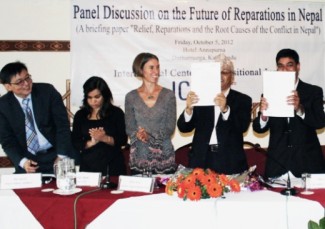
Five years since the end of Nepal's brutal civil war, victims are losing patience waiting for truth, justice, and reparation. Last year ICTJ completed a six month research project to analyze the effects of the the government's Interim Relief Program and determine the steps still required for Nepal to fulfill its obligation to provide reparations to victims. The findings have been published in a report titled “ From Relief to Reparations: Listening to the Voices of Victims.”