



420 results

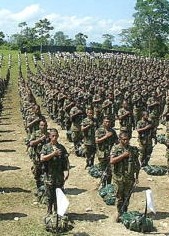
December 16, 2011 saw the world’s first ruling mandating reparations be paid for the unlawful recruitment of minors into armed forces. More than 300 former youth paramilitaries in Colombia will receive reparations including monetary compensation and medical and psychological care.

Based on interviews with 1,200 people, this study assesses conflict victims' experience with the government's Interim Relief Program since its inception in 2008. The findings are intended to inform a future reparations policy that would seek to help those whose human rights were viola...

Pablo de Greiff, director of Research at ICTJ, has presented his candidacy for the role of Special Rapporteur for the Promotion of Truth, Justice, Reparation, and Guarantees of Non-Recurrence. This new position is being established by the United Nations Human Rights Council to bring greater attention to accountability for serious crimes and human rights violations.

During a thematic hearing December 13–14, Kenya's Truth, Justice and Reconciliation Commission (TJRC) heard testimonies from children on their own experiences as part of the commission's investigation into gross human rights violations and historical injustices in the country between 1963 and 2008.

A report released today by ICTJ, together with the Indonesian Association for Families of the Disappeared (IKOHI) and the Coalition for Justice and Truth (KKPK), calls on the government to fulfill its obligations to provide reparations to thousands of victims of gross human rights violations.

JAKARTA, Dec. 12, 2011—A report released today by the International Center for Transitional Justice (ICTJ), together with the Indonesian Association for Families of the Disappeared (IKOHI) and the Coalition for Justice and Truth (KKPK), calls on the government of Indonesia to fulfill its obligation to provide reparations to thousands of victims of gross violations of human rights.

Thirteen years after the fall of Soeharto, victims in Indonesia continue to suffer from the negative effects of gross human rights violations and from ongoing discrimination. Although efforts by the president and the National Human Rights Commission (Komnas HAM) to create a reparation...

ICTJ spoke with Pablo Parenti about the trial that just concluded which investigated human rights violations and crimes against humanity that occurred at the Naval Mechanics School (ESMA), used as a detention and torture center during the Argentine dictatorship.

ICTJ interview with Pablo Parenti, of the Attorney General’s Unit for coordination and monitoring cases involving violations of human rights during the Argentine dictatorship.

ICTJ and the Center for Memory, Peace and Reconciliation of Colombia are organizing an event on Memory: Public Policy for Transformation. Dialogue at the conference will serve as the basis for providing recommendations to the process of creating the Center for Historical Memory and designing public memory policy in the country.

This report is the fourth in a series monitoring the implementation of a collective reparations program in Peru since 2007, by ICTJ and the Association for Human Rights in Peru (APRODEH). The publication examines the effects of this reparations program through interviews with the bene...

This year’s Annual Emilio Mignone Lecture on Transitional Justice, coordinated by ICTJ and the Center for Human Rights and Global Justice at the NYU School of Law, focused on the intersection between transitional justice and international development.

ICTJ enthusiastically welcomes today’s decision of the United Nations Human Rights Council to establish a mandate for a special rapporteur on the promotion of truth, justice, reparation and guarantees of non-recurrence of serious crimes and gross violations of human rights.

ICTJ filed an amicus brief in the apartheid reparations case before the Southern District Court of New York on November 25, 2009. The brief supports a decision by the South African Government not to oppose legal action against five international companies that are accused of aiding an...

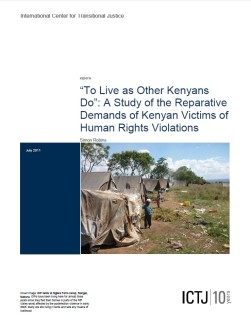
As Kenya continues to address its 2007-08 postelection violence, greater emphasis should be placed on victims’ reparative justice demands, according to a new ICTJ report. The report, “To Live as Other Kenyans Do”: A Study of the Reparative Demands of Kenyan Victims of Human Rights Violations, is a...

This paper documents the opinions of victims of human rights violations in Kenya about the country’s unfolding transitional justice process. The first section gives background into the human rights violations; the second section presents victims ideas about reparative justice. The rep...

The South African Coalition for Transitional Justice (SACTJ) submits the following comments regarding the May 11, 2010 General Notice 282 published in the Government Gazette. The Coalition objects to the Notice 282 regulations on procedural, constitutional, and international law groun...

On May 11, the South African Department of Justice and Constitutional Development (DOJ) invited comments on new regulations governing the distribution of reparations to victims of the apartheid era in the form of medical and educational benefits. Civil society organizations and groups representing survivors’ interests have raised concerns regarding the scope of the regulations, as well as the DOJ’s overall failure to engage with survivors and consider their views when drafting reparations policies.

This report provides parameters for the creation of a reparations program in Peru. The program must be included in the process of raising a new national awareness in Peru regarding past abuses and building a legal-political framework more responsive to human rights. To ensure sustaina...

This study examines various aspects of existing reparations following the 1991-1999 conflicts in the former Yugoslavia. It clarifies the different categories of reparation; identifies groups potentially entitled to compensation; assesses the extent and fairness of existing policies; a...

The Extraordinary Chambers of the Courts of Cambodia's reparations mandate may seem narrow and restrictive. Yet there are several potential ways in which the Court can make the right to reparations meaningful for civil parties and for many other Cambodians. It has the ability to inf...

This publication provides an operational framework for vetting and institutional reform. It is intended address the challenges of institutional and personnel reform in post-conflict States through the creation of vetting processes that exclude persons who lack integrity from public in...

This report outlines Indonesia's international law obligations to provide remedies to the "1965 victims" of General Soeharto's persecution and stigmatization of those affiliated with the Indonesia Communist Party. It traces the history of this persecution, provides an overview of curr...

In this amicus brief to the Indonesian Constitutional Court, ICTJ submits that the legislation establishing the Indonesian Truth and Reconciliation Commission ("TRC law") contravenes international law. ICTJ contests the provisions of the TRC law that allow for the granting of amnesty ...

This study examines the development of restitution and reparations in international law and practice over the last century. It aims to provide recommendations on how restitution can best contribute to transitional justice by reviewing four case-studies: the Czech Republic, South Afric...