


193 results

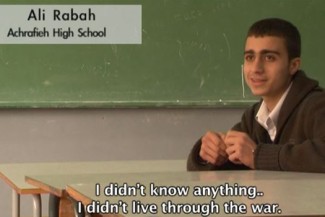
While Lebanon is post-peace agreement, it is not necessarily "post-conflict." The country struggles to address the legacy of decades of violence, and the lack of a comprehensive approach to dealing with the past means the country's youth are growing up with scant knowledge of their history. But they want to know more: one project is helping them ask those around them about the past, and giving those who lived it a chance to tell their stories.

A black-and-white photo of an open book pierced by a single bullet hole was chosen as the grand-prize winner of the International Center for Transitional Justice’s Youth Photo Contest, “THE WAR AS I SEE IT” in Lebanon. The photo, titled “Dominique,” was taken by Sibylle George, a 22-year-old architecture student at American University of Beirut.

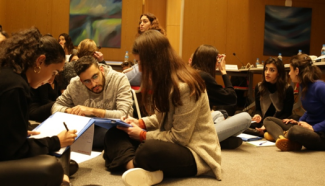
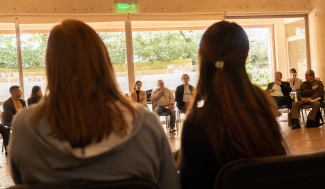
ICTJ held a two-day workshop on transitional justice for a group of university students in Beirut on February 14 and 15 as part of its ongoing support to the Committee of the Families of the Kidnapped and Disappeared in Lebanon. The students are currently serving as volunteers on a project to create an archive of the committee’s decades-long struggle and activism.

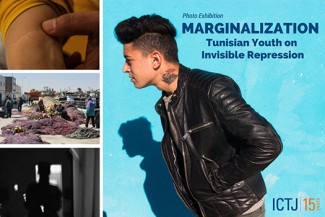
Ongoing economic and social inequality, a legacy of the dictatorship, affects Tunisians across generations, but has particularly pronounced impacts on young people. ICTJ worked with four young photographers to confront the consequences of marginalization and explore its impacts on Tunisian youth. Their four photo galleries comprise the exhibition "Marginalization in Tunisia: Images of an Invisible Repression.”

Education, as a critically important institution that is widely considered to be both formative and transformative, is something that transitional justice cannot afford to overlook. Transitional justice in its early years did not directly engage with education, but today this has chan...

As human rights advocates and state representatives increasingly acknowledge the necessity of involving children in truth-seeking processes, there is a growing need for practical tools that facilitate children’s participation while prioritizing their protection. This statement-taking ...

As subscribers, you enjoy timely commentary on what’s happening in transitional justice around the world written by one of our experts exclusively for our monthly World Report newsletter. In this month’s edition, we bid farewell to 2019 by looking back on the experts’ choices of the past year.

Maine’s foster care system was intended to act in the best interests of all children. But for indigenous children removed from their communities and placed with white families, often without the consent of their parents or tribes, the foster care system caused the painful loss of their cultural identity and traumatic severing from their heritage.

ICTJ advocates for the inclusion of mental health and psychosocial support (MHPSS) in all transitional justice initiatives and undertakes research on best practices for the field. Leading this work is ICTJ Senior Expert Virginie Ladisch. She is the lead author of the forthcoming report, ‘The Search for People’s Well-Being’: Mainstreaming a Psychosocial Approach to Transitional Justice. In this interview, Ladisch discusses the importance of MHPSS for transitional justice and her work on the topic.

On November 25, 2021, The Gambia’s Truth, Reconciliation and Reparations Commission (TRRC) presented its 17-volume final report and recommendations to President Adama Barrow, after multiple delays. The final report includes a record of serious human rights violations committed under Jammeh’s repressive regime and recommendations for pursuing justice. Despite the challenges, steps have already been taken that offer hope that the TRRC’s recommendations will take effect.