

507 results

On a historic day for justice in Guatemala and the world, the trial for Guatemala’s former military dictator José Efraín Ríos Montt began this morning in Guatemala City. Ríos Montt and his co-accused, José Mauricio Rodríguez Sánchez – are standing trial on charges of genocide and crimes against humanity during the civil war in Guatemala, in which some 200,000 people were killed or disappeared, a majority of them indigenous Maya.

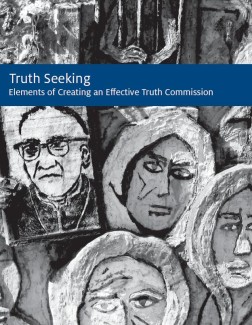
This publication provides an overview of the essential best practices guiding the main aspects of a truth commission, answering basic questions relating to its goals, powers, operations, framework, protections for commissioners and witnesses, and reporting. Its intention is to provide...

From February 27-March 1, leading indigenous rights activists from around the world will join their counterparts and other experts at Columbia University to discuss access to truth, justice, and reconciliation for indigenous peoples.

In this edition of ICTJ's Program report, Kelli Muddell, director of ICTJ's Gender Justice program, reflects on ICTJ’s vision of gender justice, the challenges facing survivors of sexual and gender-based violence in times of transition, and how ICTJ is working to address inequality in countries like Colombia, Nepal, and Tunisia.

“Judgment Denied,” a report from the ICTJ, details four military court cases in the Democratic Republic of the Congo involving dozens of victims, egregious human rights violations, and nearly $1 million in outstanding awards owed by the government. In every case, serious crimes were committed against civilians by members of the Congolese Army, but the government has yet to pay compensation ordered by the courts.

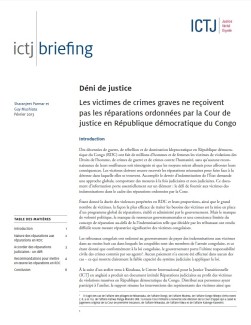
Following field research in late 2009 and a 2010 workshop in Kinshasa, ICTJ produced a report in French on the challenges of enforcing court-ordered reparations. This briefing paper outlines and summarizes the challenges and recommendations discussed in the report. It also proposes ad...

The government of Uganda should work to institute comprehensive reparations for victims of the war against the Lord's Resistance Army (LRA). So states a new report by the International Center for Transitional Justice (ICTJ) and the Justice and Reconciliation Project (JRP).

There is now an opportunity to design and implement a reparations program for victims of human rights and humanitarian law violations in Uganda. As with other countries emerging from conflict, the contours of a Ugandan reparations policy have been the subject of extended debate and ge...

Indigenous rights are increasingly being addressed through different transitional justice measures, and ICTJ is actively involved in the discourse on how truth commissions and other transitional justice mechanisms can help the struggle for the rights of indigenous people.

As the Special Court for Sierra Leone wraps up cases against accused war criminals, a conference will be held later this week in Freetown to assess the Court’s work and lasting legacy. The conference is part of a larger international effort to look at how the court has helped to bring peace and establish the rule of law for the people of Sierra Leone, Liberia, and the region as a whole.