


751 results

Almost a year after the second post-election transition in Burundi, national and international attention is focused on the willingness and ability of the new government to implement the decisions agreed to during negotiations that culminated in the historic August 2000 peace and recon...

ICTJ filed an amicus brief in the apartheid reparations case before the Southern District Court of New York on November 25, 2009. The brief supports a decision by the South African Government not to oppose legal action against five international companies that are accused of aiding an...

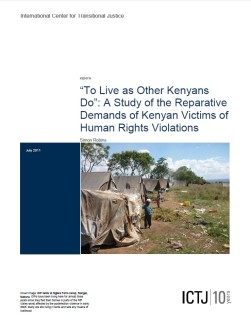
As Kenya continues to address its 2007-08 postelection violence, greater emphasis should be placed on victims’ reparative justice demands, according to a new ICTJ report. The report, “To Live as Other Kenyans Do”: A Study of the Reparative Demands of Kenyan Victims of Human Rights Violations, is a...

This paper documents the opinions of victims of human rights violations in Kenya about the country’s unfolding transitional justice process. The first section gives background into the human rights violations; the second section presents victims ideas about reparative justice. The rep...

“Residential schools affected everything about how we live. They targeted and destroyed our strong family unit, the basic foundation of our communities. They destroyed the glue that holds us together—love, respect and sharing.” These words, spoken by Charlie Furlong, a community leader of the Gwich'in people of Canada’s Northwest Territories, sum up the chilling legacy of the country’s policy of forced assimilation of indigenous cultures implemented through a system of Indian Residential Schools (IRS) from the 1870s to 1998.

The second Latin American Conference on Transitional Justice closed July 8. In the concluding remarks, ICTJ Truth and Memory Program Director Eduardo Gonzalez stated that while this conference has focused on sharing the comparative experiences throughout Latin America, this has not been an academic exercise but a call to action. Read more on the conference blog

Although Brazil's dictatorship ended years ago, focus on transitional justice there is peaking now, as debate stirs over how to best address its past. Recent developments - including the Brazilian government's proposal of a truth commission, the opening of national archives, and the Inter-American Court of Human Rights' decision limiting the 1979 amnesty law - are at the core of the discussion. Eduardo Gonzalez, director of ICTJ's Truth and Memory Program, discusses the role accountability for the past can play in Brazil today.

The Canadian Truth and Reconciliation Commission (TRC) will hold its second of seven national events from June 28 to July 1 in Inuvik, Northwest Territories. The event will provide survivors of Canada’s Indian Residential Schools (IRS) and other participants an opportunity to contribute to documenting and publicizing what took place in this program of forced assimilation.

ICTJ has released One morning they came to our community: Stories of political violence in communities of Peru, a compilation of victims’ stories about Peru’s internal armed conflict from 1980 to 2000. The stories constitute an important form of recognizing the truth, as well as a demand for justice and reparations.

The South African Coalition for Transitional Justice (SACTJ) submits the following comments regarding the May 11, 2010 General Notice 282 published in the Government Gazette. The Coalition objects to the Notice 282 regulations on procedural, constitutional, and international law groun...