


502 results

As ICTJ co-hosts a discussion on complementarity on the margins of the Assembly of State Parties (ASP) of the International Criminal Court (ICC), the principle of ensuring accountability for serious crimes has seen a major breakthrough at a recent high-level meeting at Greentree. The meeting brought together international justice actors, development practitioners, UN representatives, and national rule of law actors to discuss the practical implementation of complementarity and how to strengthen domestic systems seeking to investigate serious crimes.

NEW YORK, Dec. 14, 2011—ICTJ welcomes the election of Fatou Bensouda of Gambia as the next prosecutor of the International Criminal Court (ICC). Ms. Bensouda was unanimously elected December 12 by the Assembly of States Parties (ASP) during its 10th session in New York City, and will be the court's second prosecutor, commencing in June 2012.

Case studies on the use of pardons in Argentina, Chile, El Salvador, Peru, and South Africa.

This year marks the 20th anniversary of the publication of Children of Cain, the first book by writer and journalist Tina Rosenberg. ICTJ spoke with Rosenberg about how political violence has evolved in Latin America over the past 20 years, and the continuing need for accountability for past atrocities.

This year marks the 20th anniversary of the publication of Children of Cain, the first book by writer and journalist Tina Rosenberg. ICTJ spoke with Rosenberg about how political violence has evolved in Latin America over the past 20 years, and the continuing need for accountability for past atrocities.

This report is the fourth in a series monitoring the implementation of a collective reparations program in Peru since 2007, by ICTJ and the Association for Human Rights in Peru (APRODEH). The publication examines the effects of this reparations program through interviews with the bene...

ICTJ hosted its third Intensive Course, Truth-seeking and the Challenge of Sustainable Peace, on September 26–30. Based on concrete field experience, the participants explored the relationship between truth-seeking and peace in societies that have experienced or are still experiencing armed conflict.

The Kenya Transitional Justice Brief, a quarterly bulletin by ICTJ highlighting current developments in the field of transitional justice in Kenya. This brief focuses on the process of implementing the 2010 constitution and the political context in which this takes place, providing a ...

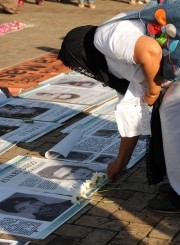
In a conversation dedicated to the International Day of the Disappeared, Eduardo Gonzalez, director of ICTJ’s Truth and Memory Program talks to Jose Pablo Baraybar, director of the Peruvian Forensic Anthropology Team. Gonzalez and Baraybar explore why it is crucial for societies in transition to address the issue of the disappeared, the tension between demands of conventional justice and the right to truth, and the need for a strategy in searching for the disappeared.

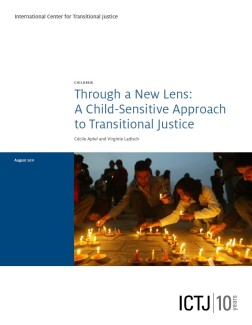
“Through a New Lens: A Child-Sensitive Approach to Transitional Justice” analyzes experiences of four countries—Liberia, Democratic Republic of Congo (DRC), Colombia and Nepal—and identifies some key lessons on children’s participation in transitional justice measures. Authored by Céc...