


480 results

Essential among South Africa's transition programs was a process to disarm, demobilize, and reintegrate ex-combatants and to create a new defense force integrating the armed forces of opposing parties into a united military structure. Yet, DDR remained largely independent from other t...

There was no formal relationship between Disarmament, Demobilization, Rehabilitation and Reintegration (DDRR) processes and transitional justice initiatives in Liberia. DDRR was near completion by the time the TRC began operations. This sequencing of the DDRR program prior to the TRC ...

There was no formal relationship between Disarmament, Demobilization, Rehabilitation and Reintegration (DDRR) processes and transitional justice initiatives in Liberia. DDRR was near completion by the time the TRC began operations. This sequencing of the DDRR program prior to the TRC ...

While Rwanda has gone further than any other post-conflict state in prosecuting lower-level perpetrators for mass atrocity, transitional justice mechanisms were deliberately kept separate from the DDR program. On one hand, DDR largely succeeded despite a firm policy against amnesty. O...

In Sierra Leone, the disarmament, demobilization and reintegration (DDR) process and transitional justice initiatives occurred in temporal proximity. Disarmament and demobilization were largely successful in Sierra Leone. Some research suggests, however, that accountability measures h...

In Sierra Leone, the disarmament, demobilization and reintegration (DDR) process and transitional justice initiatives occurred in temporal proximity. Disarmament and demobilization were largely successful in Sierra Leone. Some research suggests, however, that accountability measures h...

In collaboration with the Brookings-LSE Project on Internal Displacement, ICTJ’s Research Unit examined how transitional justice can be used to address the range of injustices associated with displacement and thereby serve as part of a comprehensive approach to the resolution of displ...

In a society grappling with the legacy of the past, citizens must make informed judgements and disentangle the facts from the sticky web of political rhetoric, denial, and polarizing propaganda. To do so, they rely on one key agent of social change: the media. But how can transitional processes effectively partner with the media and engage key constituencies? And what happens when media play a decisively negative role in mediating information about war crimes?

This report summarizes the findings of an ICTJ research project on the contribution of transitional justice to prevention. Drawing from five country case studies, it contends that addressing the past can help to prevent the recurrence not only of human rights violations but also viole...

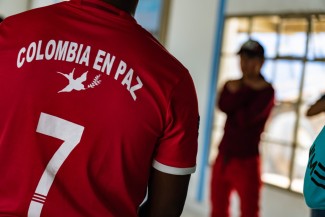
A young person with back facing the viewer is wearing a T-shirt that reads “Colombia in Peace"

To mark International Women’s Day, we invite you to read about four countries at the top of our gender justice priorities in the coming year, each with its own history, context, and complex sets of challenges.