

480 results

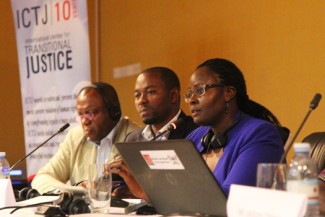
Civil society leaders, members of victims' groups and state officials throughout the Great Lakes region will convene in Kampala, Uganda next week at a conference hosted by ICTJ. Attendees will share their experiences working for redress in their communities and discuss what strategies have proven effective at the local level.

Human Rights Network-Uganda (HURINET-U), The Uganda Coalition on the International Criminal Court (UCICC), The International Center for Transitional Justice, Avocats San Frontiers and Atrocities Watch are dismayed to learn that Government of Uganda has extended an invitation to President Omar al...

After a society is torn apart by conflict or repression, who decides whether to remember or forget the painful past? Can forgiveness happen without acknowledgement of wrongdoing? Is there a difference between forgetting and denial? Join us as ICTJ debates the impact of remembrance on reconciliation with David Rieff and Pablo de Greiff.

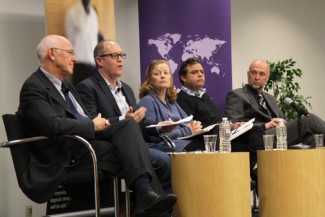
What happens when a state refuses to acknowledge the suffering of victims of mass atrocities? Or when the public celebrates perpetrators as heroes? Earlier this month, a panel discussion hosted by The International Center for Transitional Justice and New York University’s Center for Global Affairs grappled with the impact of denial on justice.

ICTJ welcomes the announcement of formal peace talks between the Government of Colombia and the National Liberation Army (ELN). This new process opens the possibility of achieving comprehensive peace in the country and entering a new phase in Colombian history.

As we search for ways to halt the violence and foster lasting peace in societies grappling with a legacy of massive human rights abuse, there is arguably no more important day to reflect upon the importance of the struggle for truth and justice than today, March 24. Thus, we take a moment to mark the International Day for the Right to the Truth concerning Gross Human Rights Violations and for the Dignity of Victims.

Eastern DRC continues to be affected by conflict and serious crimes continue to be committed against civilians living in the area by the national army (FARDC), national armed groups, and foreign armed forces. Holding perpetrators accountable is essential to dismantling the structures that allow the ongoing cycle of abuses to continue in the DRC.

The International Center for Transitional Justice (ICTJ) and the Barcelona International Peace Resource Center (BIPRC) are pleased to announce an Intensive Course on Transitional Justice and Peace Processes, taking place in Barcelona, Spain, June 6 - 10, 2016. It will focus on practical examples of recent or paradigmatic peace processes where the question of justice formed a significant part of the negotiating context.

On International Women's Day, ICTJ Gender Justice Senior Associate Amrita Kapur highlights how insecurity affects women and is key to overcoming inequality across all dimensions of empowerment. "Without including institutional reform, we are condemning women to another century of inequality," she writes in this op-ed.

ICTJ and the Human Rights and Atrocity Prevention Clinic at Benjamin N. Cardozo School of Law are pleased to announce a strategic research partnership to examine international law and practice regarding enforced disappearance and the missing.