427 results

Forced disappearance is a crime against humanity. The decisions made by politicians and officials authorizing such practices in different countries cannot be justified legally or morally. They must be held to account and be shown for what they are: enemies of a civilized society.

As the world marks August 30, the International Day of the Disappeared, we are reminded that forced disappearances and transitional justice share a common history. Indeed, processes working in concert that came to form the field of transitional justice were born from the search for truth and justice about the disappeared.

On August 9, 2012, UN Special Rapporteur on the promotion of truth, justice, reparation, and nonrecurrence Pablo de Greiff presented the first annual report to the Human Rights Council. The report provides an overview of key activities undertaken by the Special Rapporteur between May 1 and July 25, reviews the foundations of the mandate and outlines the strategy for its implementation.

When 26-year old Tunisian street vendor Mohamed Bouazizi incinerated himself on December 17, 2010, his act resonated across an entire region and sparked what is known as the Arab Spring. His cry echoed across the world because it was a universal call for justice, basic fairness, and equal treatment. Indeed, it was a call for the rule of law. In a new op-ed, ICTJ's President David Tolbert calls upon the UN General Assembly to prove its commitment to justice and the rule of law.

An internal armed conflict involving the government, leftist guerrillas, and a variety of paramilitary groups and criminal bands has endured in Colombia for the last 60 years, generating massive levels of displacement. A comprehensive truth commission that investigates major human rig...

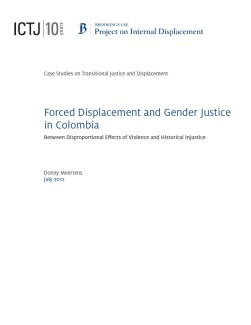
This paper examines the relationship between forced displacement and transitional justice in Colombia from a gender perspective. The text focuses on three main themes: first, the gendered impacts of forced displacement; second, the ways that official policy, as it has evolved from pro...

The reparations policy for victims of Peru’s internal armed conflict, which lasted from 1980 to 2000, includes the internally displaced population among its beneficiaries under the Official Register of Victims. However, displaced persons are given lower priority than the other categor...

The crime of forced displacement has been a widespread practice in Colombia’s internal armed conflict for several decades. However, forced displacement cannot be reduced to an inherent or unintended effect of the conflict. The armed actors in the Colombian armed conflict—the army and ...

The ICTJ Program Report is a new online feature that presents ICTJ’s work and impact around the globe. Through monthly in-depth interviews with our experts, the ICTJ Program Report will offer a view of ICTJ’s work on reparations, criminal justice, truth and memory and other transitional justice developments in countries where we work. To launch the series, we speak with Paul Seils, ICTJ's vice president and the head of our Program Office.

Argentina’s trials for crimes committed during the dictatorship of military juntas are widely seen as a successful national effort to seek accountability for past abuses. And while victims’ demands for justice continue to remain high, the judiciary is facing challenges to ensure the cases are dealt with expeditiously and fairly. In a interview for ICTJ's Spanish podcast series "Lessons from Latin America," Mirna Goransky, Assistant General Prosecutor for the Attorney General’s Office shares her perspectives on human rights trials in Argentina.