

407 results

New York—On February 26, ICTJ and NYU Law’s Center for Human Rights and Global Justice will welcome former President of Colombia and Nobel Peace Prize Laureate Juan Manuel Santos for a conversation on the role of transitional justice in peace negotiations.

In a number of countries around the world, governments have created state-administered reparations programs for victims and communities that were most affected by massive human rights violations. The success of these programs, which often involve thousands of individuals, depends in p...

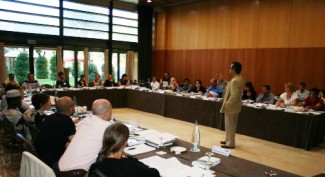
The Fourth Intensive Course on Truth Commissions, presented by ICTJ in partnership with the Barcelona International Peace Resource Center (BIPRC), focuses this year on the challenge of recognizing the experiences of vulnerable populations in the work of truth commissions. Practitioners and academics representing 17 countries will participate in the week-long course, including members of the Brazilian and Ivorian Truth Commissions, the Maine Wabanaki-State Child Welfare TRC Process, and ICTJ experts from around the world.

Colombia currently faces a transformed, fragmented form of violence centered on territorial and social control rather than the traditional insurgency. This briefing paper argues that state security strategies remain misaligned, relying on outdated military approaches and metrics. To a...

Image of first page of the briefing paper "From Combat to Territorial Control"

Colombia currently faces a transformed, fragmented form of violence centered on territorial and social control rather than the traditional insurgency. This report argues that state security strategies remain misaligned, relying on outdated military approaches and metrics. To avoid lon...

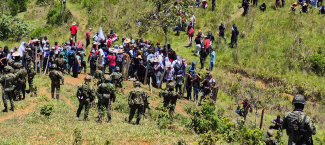
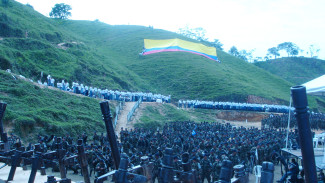
An aerial view of a group of soldiers interacting with a large civilian crowd in a rural setting

To commemorate the 20th anniversary of the Justice and Peace Law—which created Colombia's first transitional justice system—media outlet Verdad Abierta, the Friedrich Ebert Stiftung, and ICTJ partnered to produce an investigative four-part series in Spanish that critically assesses its legacy. Now translated into English, this first installment provides an overview of the process.

This report examines Colombia’s Victims and Land Restitution Law (2011), which provides comprehensive reparations to conflict victims and restitution to victims of forced displacement who rely on land for their livelihoods – and assesses the challenges of implementing the law under cu...

This study explores specialized units established in 23 countries to investigate and prosecute serious international crimes. Notwithstanding the challenges faced by these units, the study concludes that countries with a specialized institutional approach are considerably more successf...

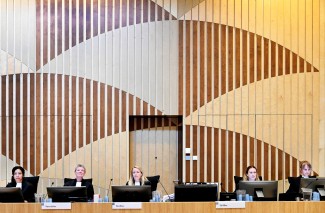
several judges dressed in black gowns sit on a judicial bench.

On Tuesday, March 19, the genocide trial of General Efraín Ríos Montt began at the High Risk Tribunal in Guatemala. To talk about this historic development in Guatemala’s pursuit of accountability we talk with us one of the key players: Guatemalan Attorney General Claudia Paz y Paz Bailey

On a historic day for justice in Guatemala and the world, the trial for Guatemala’s former military dictator José Efraín Ríos Montt began this morning in Guatemala City. Ríos Montt and his co-accused, José Mauricio Rodríguez Sánchez – are standing trial on charges of genocide and crimes against humanity during the civil war in Guatemala, in which some 200,000 people were killed or disappeared, a majority of them indigenous Maya.