407 results

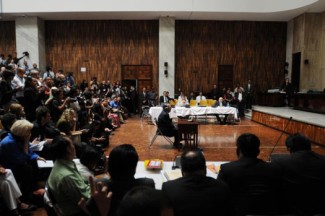
In this op-ed, ICTJ's Marcie Mersky argues that the significance of the genocide trial for José Efraín Ríos Montt stretches far beyond Guatemala: it is the first time that a former head of state is being tried for genocide in a credible national court, by the national authorities, in the country where the alleged crimes took place.

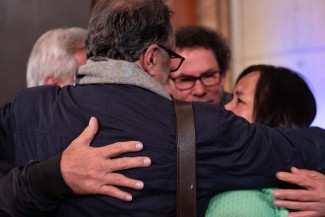
On June 21-23, Colombia’s Special Jurisdiction of Peace (JEP) held its first acknowledgment hearing on the taking hostages, serious deprivation of liberty, and other concurrent crimes (known as Case 01) in Bogotá. Seven former leaders of the guerrilla group Revolutionary Armed Forces of Colombia—People’s Army (FARC-EP) acknowledged their command responsibility for the kidnapping crimes that were the FARC-EP’s policy from 1993 to 2012 in the presence of victims, JEP officials, civil society representatives, and members of the press. This hearing marks the first time ever FARC-EP leaders publicly acknowledged their role in such systemic crimes. A decisive step in the country’s restorative justice process, it would not have been possible without years of preparation.

On February 26, 2020, the International Center for Transitional Justice and NYU Law’s Center for Human Rights and Global Justice welcomed former President of Colombia and Nobel Peace Prize Laureate Juan Manuel Santos for a conversation on the role of transitional justice in peace negoti...

The field of transitional justice is increasingly recognizing the relevance of mental health and psychosocial support (MHPSS) in contexts of massive human rights violations. Despite growing advocacy and awareness at the global policy level, however, the field lacks a systematic approa...

an image of colorful painting featuring a young girl

Canadian youth not only want to know the truth about what happened at the Indian Residential Schools –they want to learn about it in their classrooms.

A significant portion of Colombian society has been indifferent to the pain of those who lived through the war in the flesh. Some have even denied the existence of an internal armed conflict. This is why it is necessary for us to recount our early and recent history. A new, more comprehensive and nuanced narrative must emerge from the testimonies of victims, responsible parties, and even spectators of this unending war.

Fania Davis thinks the time has come for a truth-telling process about racial injustice in the United States, and she is working to make it a reality. We sat down with her and her colleague, Jodie Geddes, to discuss their vision for a national process, what they hope it would achieve, and what they have learned from their conversations with local leaders so far.

In the wake of Charlottesville, some took to Twitter to distance the United States from the white supremacist march using #ThisIsNotUs. But this is us, writes Virginie Ladisch, and white Americans have an obligation to educate themselves about the history and persistence of white supremacy in their country.

In December, ICTJ partnered with NYU School of Law and the Center for Human Rights and Global Justice to host Auschwitz survivor and Judge Thomas Buergenthal for the 7th Annual Emilio Mignone Lecture on Transitional Justice.

ICTJ and the Center for Human Rights and Global Justice at NYU School of Law are pleased to announce that Judge Thomas Buergenthal will be the speaker of the 7th Annual Emilio Mignone Lecture on Transitional Justice. Buergenthal is one of the world’s most distinguished jurists, whose name is synonymous with human rights and international justice. The lecture will be held on Thursday, December 12, from 6:00 to 7:30pm, in New York City.