407 results

This report provides parameters for the creation of a reparations program in Peru. The program must be included in the process of raising a new national awareness in Peru regarding past abuses and building a legal-political framework more responsive to human rights. To ensure sustaina...

In this op-ed, ICTJ Vice President Paul Seils analyzes the criminal justice agreement announced by the Government of Colombia and the FARC and discusses what aspects of the deal need clarification to ensure that it is capable of delivering the kind of truth and justice that victims of Colombia's armed conflict deserve.

The Documentation Affinity Group (DAG) was established in 2005 by ICTJ and five partner organizations as a peer-to-peer network with a primary focus on human rights documentation. Documenting Truth collects the best practices derived from the work of the DAG organizations in Cambodia,...

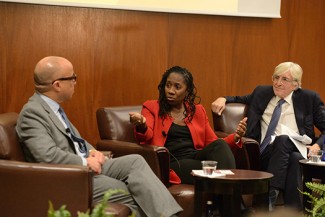
Do the concepts and strategies of transitional justice have a role to play in the United States? Our 2017 Emilio Mignone Lecture asked that question, with Darren Walker, President of the Ford Foundation, and Sherrilyn Ifill, President and Director-Counsel of the NAACP Legal Defense Fund, joining ICTJ's David Tolbert in conversation. Watch the full discussion here.

Enforced disappearances are among the cruelest of crimes. To the kidnapping, torture, and in many cases, murder of the victim, perpetrators intentionally create fear and uncertainty about the fate of the missing person. Although men are predominantly targeted, the impact on women is severe and lasting.

On International Children’s Day, ICTJ reaffirms the importance of an active role of children and youth in transitional justice processes, such as truth-seeking, criminal accountability, and reparations programs. In the aftermath of societal upheaval, the voices of children and youth are often absent from peace negotiations and subsequent transitional processes. Though children and youth must be able to receive adequate care and necessary rehabilitation, they must not be regarded only as victims of massive human rights abuses: they are rights-bearing members of a society trying to confront the past, and active participants in the process of social change aiming for a new future. It is in the best interest of children and youth, as well as the societies in which they live, to participate in transitional justice processes, devised to reestablish rule of law and civic trust in the societies to which they belong.


Research Brief: Selected examples of Defence, Intelligence and Justice Investigative Reports into detention and interrogation practices.

ICTJ partnered with the Center for Global Affairs at New York University to explore how political will of international and national actors impacts national war crimes proceedings. The panel examined four diverse country scenarios - the Democratic Republic of the Congo, Serbia, Iraq, and Guatemala.

More truth commissions are being created now through peace agreements than at any other time in history. But are they living up to high expectations for truth, accountability, and reconciliation in societies emerging from violent conflicts? This week, the Kofi Annan Foundation and the International Center for Transitional Justice (ICTJ) held a three-day, high-level symposium to explore the challenges and benefits of truth commissions emerging from peace processes.