



256 results

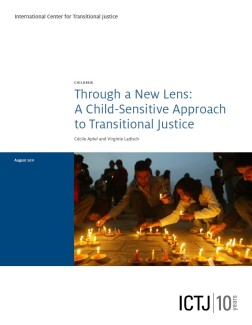
“Through a New Lens: A Child-Sensitive Approach to Transitional Justice” analyzes experiences of four countries—Liberia, Democratic Republic of Congo (DRC), Colombia and Nepal—and identifies some key lessons on children’s participation in transitional justice measures. Authored by Céc...

Indonesia and Timor-Leste created the Commission for Truth and Friendship (CTF) bilaterally in 2005. The commission has not yet delivered substantive transitional-justice benefits, and its public hearings have seriously compromised the goals of truth and resconciliation. This report i...

Transforming a Legacy of Genocide presents the findings of a November 2007 survey of visitors to Choeung Ek, a public memorial of one of Cambodia's notorious "killing fields" during the Khmer Rouge regime, where approximately 20,000 people were killed between 1975 and 1979. The survey...

This research report offers guidance on the application of a restorative justice framework in contexts of massive human rights violations, including its advantages and challenges. Based on the experiences of Colombia, Sierra Leone, Tunisia, and the Philippines, the study examines how ...

A man and audience member holds his phone to record proceedings of panel on the stage in front of him.

In 1996, six years after Nepal replaced its absolute monarchy with multi-party democracy, Maoist rebels launched an armed struggle that led to an estimated 13,000 deaths over the next decade. In November 2006 the rebels and government made peace, paving the way for the abolition of th...

Demobilization was first initiated in Cambodia in 1992, but there have been few attempts to link disarmament, demobilization and reintegration (DDR) processes to transitional justice measures. The government's overriding consideration has been the preservation of stability, narrowly i...

Demobilization was first initiated in Cambodia in 1992, but there have been few attempts to link disarmament, demobilization and reintegration (DDR) processes to transitional justice measures. The government's overriding consideration has been the preservation of stability, narrowly i...

In Afghanistan's nation-building process, security has been prioritized over justice. Slow progress on crucial institutional reforms continues to impede efforts to create a competent and professional police force, a functioning civil service, and an accountable judiciary; all thr...

In collaboration with the Brookings-LSE Project on Internal Displacement, ICTJ’s Research Unit examined how transitional justice can be used to address the range of injustices associated with displacement and thereby serve as part of a comprehensive approach to the resolution of displ...

In a society grappling with the legacy of the past, citizens must make informed judgements and disentangle the facts from the sticky web of political rhetoric, denial, and polarizing propaganda. To do so, they rely on one key agent of social change: the media. But how can transitional processes effectively partner with the media and engage key constituencies? And what happens when media play a decisively negative role in mediating information about war crimes?