

429 results

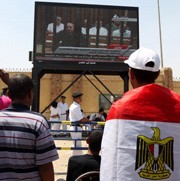
The appearance of Hosni Mubarak in the opening of his trial this week reassured millions of Egyptians that their revolutionary struggle was not in vain. But the truth about Mubarak’s ability to participate in his trial is still unclear. With the public doubting the court’s seriousness, Mubarak’s appearance could have been a political decision aimed at boosting confidence. If this is the case, the judiciary risks appearing politicized in the eyes of Egyptians.

ICTJ filed an amicus brief in the apartheid reparations case before the Southern District Court of New York on November 25, 2009. The brief supports a decision by the South African Government not to oppose legal action against five international companies that are accused of aiding an...

This report describes the Supreme Iraqi Criminal Tribunal. It discusses the court's establishment and organization, jurisdiction, individual criminal responsibility, rules of procedure and evidence, and general principles of criminal law. It examines, in depth, the guidelines and fram...

The South African Coalition for Transitional Justice (SACTJ) submits the following comments regarding the May 11, 2010 General Notice 282 published in the Government Gazette. The Coalition objects to the Notice 282 regulations on procedural, constitutional, and international law groun...

The International Criminal Court (ICC) must better communicate what is driving its actions to the public of the Middle East and North Africa (MENA) and elsewhere around the world if it is to develop confidence in its capacity to act as a guardian of international criminal law.

On May 11, the South African Department of Justice and Constitutional Development (DOJ) invited comments on new regulations governing the distribution of reparations to victims of the apartheid era in the form of medical and educational benefits. Civil society organizations and groups representing survivors’ interests have raised concerns regarding the scope of the regulations, as well as the DOJ’s overall failure to engage with survivors and consider their views when drafting reparations policies.

This report traces the human rights abuses under King Hassan II—including arbitrary arrest, torture, and disappearance—that led to the development of the Moroccan Equity and Reconciliation Commission (Instance Équité et Réconciliation (IER)). It provides both a historical reference an...

This paper discusses the significance of the trials of Saddam Hussein and his close associates held by the Supreme Iraqi Criminal Tribunal. It examines the challenges faced by the Tribunal - including concerns that the process was dominated by the U.S. government (hence undermining t...

This paper summarizes the basic facts about the Dujail trial, the first trial before the Iraqi High Tribunal (IHT) against Saddam Hussein and seven others. It also summarizes facts about the IHT in general. It considers both what the Iraqis wanted out of the trial, what such prosecuti...

This update series summarizes developments in the Anfal trial of Saddam Hussein, his cousin Ali Hassan al-Majid, and five other co-defendants before the Iraqi High Tribunal. It covers the trial's defense and closing phases. Five of the six defendants were sentenced to either multiple ...