


376 results

This research report offers guidance on the application of a restorative justice framework in contexts of massive human rights violations, including its advantages and challenges. Based on the experiences of Colombia, Sierra Leone, Tunisia, and the Philippines, the study examines how ...

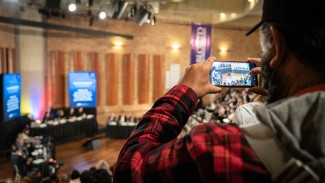
A man and audience member holds his phone to record proceedings of panel on the stage in front of him.

In the span of only one month, Tunisia has witnessed the historic passing of a transitional justice law and adoption of a new constitution. A key actor in the country's transition is the media.

In collaboration with the Brookings-LSE Project on Internal Displacement, ICTJ’s Research Unit examined how transitional justice can be used to address the range of injustices associated with displacement and thereby serve as part of a comprehensive approach to the resolution of displ...

In a society grappling with the legacy of the past, citizens must make informed judgements and disentangle the facts from the sticky web of political rhetoric, denial, and polarizing propaganda. To do so, they rely on one key agent of social change: the media. But how can transitional processes effectively partner with the media and engage key constituencies? And what happens when media play a decisively negative role in mediating information about war crimes?

This report summarizes the findings of an ICTJ research project on the contribution of transitional justice to prevention. Drawing from five country case studies, it contends that addressing the past can help to prevent the recurrence not only of human rights violations but also viole...

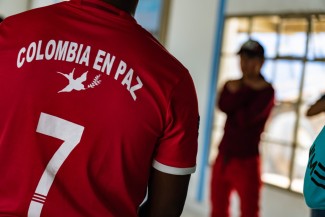
A young person with back facing the viewer is wearing a T-shirt that reads “Colombia in Peace"

To mark International Women’s Day, we invite you to read about four countries at the top of our gender justice priorities in the coming year, each with its own history, context, and complex sets of challenges.

This study explores a transitional justice approach to the dilemma of foreign fighters in violent conflict. Such an approach can help center human rights in comprehensive responses to foreign fighters, and shift the current focus from security and punishment to justice and long-term p...

Image of Children looking through holes in a tent at al-Hol displacement camp in Hasaka governorate, Syria, on April 2, 2019.

Transitional justice processes have a fundamental public dimension: their impact depends in part on the social support they receive. Beyond outreach programs, other initiatives, such as media and cultural interventions, can strengthen—or in some cases undermine—the public resonance of...

This report traces the human rights abuses under King Hassan II—including arbitrary arrest, torture, and disappearance—that led to the development of the Moroccan Equity and Reconciliation Commission (Instance Équité et Réconciliation (IER)). It provides both a historical reference an...

The protracted displacement of Palestinian refugees presents a complex set of challenges for the international refugee, humanitarian, and transitional justice fields. For the most part, these global movements have treated the Palestinian situation as a case apart: Palestinian refugees...