247 results

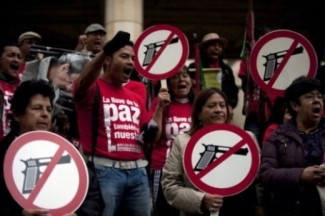
This Wednesday saw the beginning of formal peace talks between the Colombian Government of Juan Manuel Santos and the leadership of the left-wing FARC guerrillas. This op-ed from ICTJ Vice President Paul Seils argues that a successful outcome will not be measured simply in the effective demobilization of roughly 8,000 militants. Durable peace will require a reimagining of the Colombian state, which has become both victim and perpetrator in a conflict now over half a century old.

An end could be in sight for the longest-running armed conflict in the Western Hemisphere. Peace negotiations between the government and the Revolutionary Armed Forces of Colombia (FARC) rebels have begun on 17 October in Oslo, Norway, and will continue in Havana, Cuba.

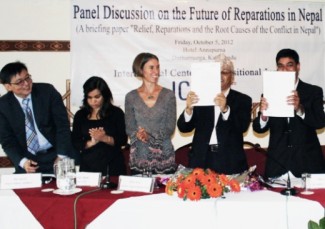
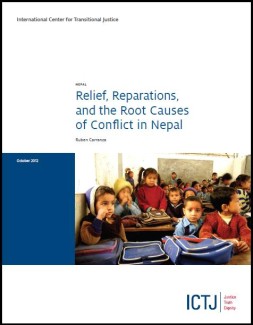
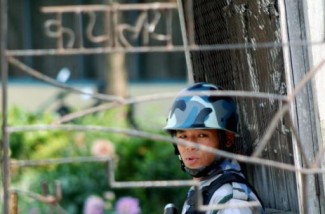
Six years after a peace agreement formally ended the conflict in Nepal, the slow, painstaking process of building the country’s new democracy has yet to provide comprehensive reparation to victims. To fully acknowledge the experience of victims of the conflict, Nepal’s government should not mistake the issuance of relief through material benefits for the implementation of a comprehensive reparation program. This is one of the central recommendations of "Relief, Reparations, and the Root Causes of Conflict in Nepal," a major new report from ICTJ, and authored by Ruben Carranza.

The report examines the measures taken in Nepal to redress victims following the 2006 peace agreement, which formally ended the ten-year civil war between the government and Maoist rebels. It looks closely at the Interim Relief Program (IRP) — a compensation scheme instituted in 2008 ...

On October 2, an award ceremony honored the winners of the amateur photography contest on memory, called “Images to Resist Oblivion,” organized by the Center for Historical Memory and the International Center for Transitional Justice (ICTJ). View photo galleries from the three winning submissions.

The latest ICTJ Program Report explores transitional justice issues in Colombia and charts our work in the country with the longest running armed conflict in the world. In this interview, head of ICTJ's Colombia office Maria Camila Moreno answers questions on the ongoing transitional justice mechanisms in the country, and describes ICTJ's work with the government and civil society groups on issues of criminal justice, reparations and memory. She provides a look ahead to the new peace negotiations between the Colombian government and the FARC, and identifies key transitional justice issues at stake for the talks.

As the world marks August 30, the International Day of the Disappeared, we are reminded that forced disappearances and transitional justice share a common history. Indeed, processes working in concert that came to form the field of transitional justice were born from the search for truth and justice about the disappeared.

Nepal’s armed conflict ended six years ago, but commitments made to pursue accountability and establish oversight over security forces have yet to be implemented. ICTJ’s briefing paper “Building Trust and Strengthening the Rule of Law” examines how an ad hoc vetting mechanism for officers in senior command positions could help consolidate democracy in Nepal. Author Alexander Mayer-Rieckh says that as Nepal abandons its commitments to pursue accountability for serious crimes, it undermines the ability of its security forces to maintain the rule of law and protect a new era of peace.

ICTJ’s briefing paper “Building Trust and Strengthening the Rule of Law” examines how an ad hoc vetting mechanism for officers in senior command positions could help consolidate democracy in Nepal. Author Alexander Mayer-Rieckh says that as Nepal abandons its commitments to pursue acc...

An internal armed conflict involving the government, leftist guerrillas, and a variety of paramilitary groups and criminal bands has endured in Colombia for the last 60 years, generating massive levels of displacement. A comprehensive truth commission that investigates major human rig...