


442 results

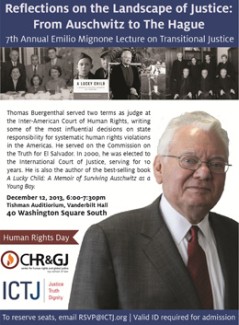
ICTJ and the Center for Human Rights and Global Justice at NYU School of Law are pleased to announce that Judge Thomas Buergenthal will be the speaker of the 7th Annual Emilio Mignone Lecture on Transitional Justice. Buergenthal is one of the world’s most distinguished jurists, whose name is synonymous with human rights and international justice. The lecture will be held on Thursday, December 12, from 6:00 to 7:30pm, in New York City.

A short biography of Hebert Veloza Garcia aka "H.H."

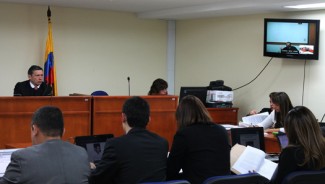
The Justice and Peace Chamber ruling in the hearing to verify the legality of the charges against Hebert Veloza Garcia contained information on the context in which these occurred. According to the Tribunal, it thus seeks to “contribute elements that underpin the analysis of the modus operandi, the patterns, if any, and the dynamics in which the criminal structure under the command of Hebert Veloza Garcia, alias “H.H.” was organized, as well as to “establish the judicial truth with respect to the criminal actions of the paramilitary groups in different regions of the country.”

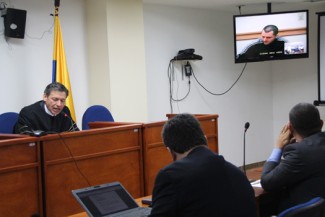
The first verdict in the Justice and Peace process case against paramilitary commander Hebert Veloza Garcia, alias “H.H.”, will be announced on October 30, and will be a landmark in Colombia's compliance with its obligation to investigate, prosecute, and sanction those who have committed international crimes and serious human rights violations in the country.

Next week, the Colombian courts will issue the first partial verdict in the Justice and Peace case against the paramilitary leader Hebert Veloza García, alias “HH,” one of the most significant cases of the Justice and Peace process. Ahead of the HH partial verdict on October 30th, ICTJ is launching a comprehensive timeline on transitional justice measures implemented in Colombia since 2005 that recognize victims' rights to truth, justice, reparations, and the guarantee of non-recurrence.

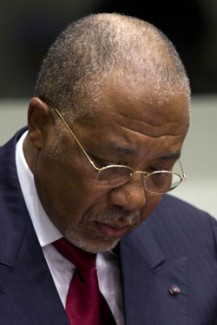
The significance of Charles Taylor’s judgment rendered few days ago in The Hague goes far beyond Taylor himself, or even the Special Court for Sierra Leone. This decision will be an unavoidable legal precedent in any future deliberation of the role played by leaders and states in crimes committed by forces they support in other countries, writes ICTJ's president David Tolbert in this op-ed.

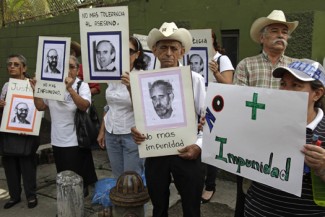
For more than 20 years, the Amnesty Law has hindered El Salvador from pursuing accountability for perpetrators of serious crimes committed against civilians during the civil war fought between the government and leftist insurgents in the 1980's. However, this may change in very near future. On September 20, the Constitutional Court admitted a petition claiming that the Amnesty Law passed in March 1993 –which shielded perpetrators of serious crimes committed during the 12-year civil war– is unconstitutional.

ICTJ's documentary Voices of Dignity inspired Wilson Herrera, professor of philosophy and researcher at the Universidad del Rosario in Colombia, to reflect on the role of victims in a democratic society, and on the importance of empowering them as agents of change and rights-holders, rather than relegating them to the status of permanent victims.

ICTJ welcomes the decision by the Special Court for Sierra Leone to uphold the guilty verdict against former Liberian President Charles Taylor for war crimes and crimes against humanity. The court dismissed challenges from Taylor’s defense, and the prosecution’s request for the sentence to be increased to 80 years, and affirmed his 50-year sentence with immediate effect.

ICTJ welcomes the 6th National Event of Canada's Truth and Reconciliation Commission, part of the TRC’s journey towards completion of its mandate: to learn the truth about what happened in the residential schools, and to inform all Canadians about this history.