455 results

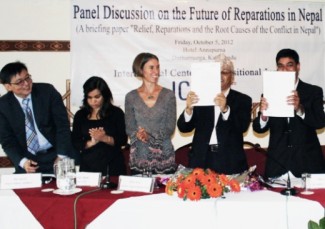
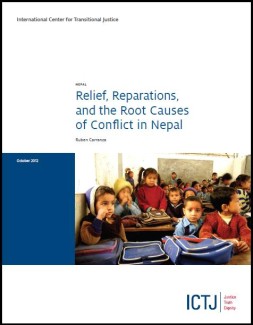
The report examines the measures taken in Nepal to redress victims following the 2006 peace agreement, which formally ended the ten-year civil war between the government and Maoist rebels. It looks closely at the Interim Relief Program (IRP) — a compensation scheme instituted in 2008 ...

On October 2, an award ceremony honored the winners of the amateur photography contest on memory, called “Images to Resist Oblivion,” organized by the Center for Historical Memory and the International Center for Transitional Justice (ICTJ). View photo galleries from the three winning submissions.

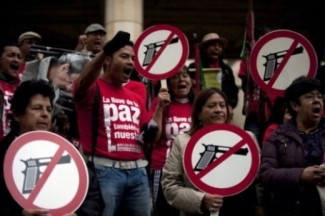
The latest ICTJ Program Report explores transitional justice issues in Colombia and charts our work in the country with the longest running armed conflict in the world. In this interview, head of ICTJ's Colombia office Maria Camila Moreno answers questions on the ongoing transitional justice mechanisms in the country, and describes ICTJ's work with the government and civil society groups on issues of criminal justice, reparations and memory. She provides a look ahead to the new peace negotiations between the Colombian government and the FARC, and identifies key transitional justice issues at stake for the talks.

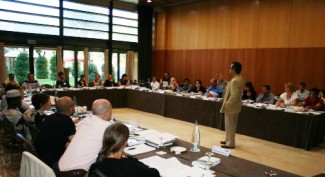
The Fourth Intensive Course on Truth Commissions, presented by ICTJ in partnership with the Barcelona International Peace Resource Center (BIPRC), focuses this year on the challenge of recognizing the experiences of vulnerable populations in the work of truth commissions. Practitioners and academics representing 17 countries will participate in the week-long course, including members of the Brazilian and Ivorian Truth Commissions, the Maine Wabanaki-State Child Welfare TRC Process, and ICTJ experts from around the world.

Forced disappearance is a crime against humanity. The decisions made by politicians and officials authorizing such practices in different countries cannot be justified legally or morally. They must be held to account and be shown for what they are: enemies of a civilized society.

As the world marks August 30, the International Day of the Disappeared, we are reminded that forced disappearances and transitional justice share a common history. Indeed, processes working in concert that came to form the field of transitional justice were born from the search for truth and justice about the disappeared.

On August 9, 2012, UN Special Rapporteur on the promotion of truth, justice, reparation, and nonrecurrence Pablo de Greiff presented the first annual report to the Human Rights Council. The report provides an overview of key activities undertaken by the Special Rapporteur between May 1 and July 25, reviews the foundations of the mandate and outlines the strategy for its implementation.

Nepal’s armed conflict ended six years ago, but commitments made to pursue accountability and establish oversight over security forces have yet to be implemented. ICTJ’s briefing paper “Building Trust and Strengthening the Rule of Law” examines how an ad hoc vetting mechanism for officers in senior command positions could help consolidate democracy in Nepal. Author Alexander Mayer-Rieckh says that as Nepal abandons its commitments to pursue accountability for serious crimes, it undermines the ability of its security forces to maintain the rule of law and protect a new era of peace.

ICTJ’s briefing paper “Building Trust and Strengthening the Rule of Law” examines how an ad hoc vetting mechanism for officers in senior command positions could help consolidate democracy in Nepal. Author Alexander Mayer-Rieckh says that as Nepal abandons its commitments to pursue acc...

When 26-year old Tunisian street vendor Mohamed Bouazizi incinerated himself on December 17, 2010, his act resonated across an entire region and sparked what is known as the Arab Spring. His cry echoed across the world because it was a universal call for justice, basic fairness, and equal treatment. Indeed, it was a call for the rule of law. In a new op-ed, ICTJ's President David Tolbert calls upon the UN General Assembly to prove its commitment to justice and the rule of law.