


492 results

The Kenya Transitional Justice Brief, a quarterly bulletin by ICTJ highlighting current developments in the field of transitional justice in Kenya. This brief focuses on the process of implementing the 2010 constitution and the political context in which this takes place, providing a ...

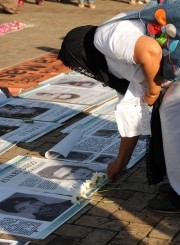
In a conversation dedicated to the International Day of the Disappeared, Eduardo Gonzalez, director of ICTJ’s Truth and Memory Program talks to Jose Pablo Baraybar, director of the Peruvian Forensic Anthropology Team. Gonzalez and Baraybar explore why it is crucial for societies in transition to address the issue of the disappeared, the tension between demands of conventional justice and the right to truth, and the need for a strategy in searching for the disappeared.

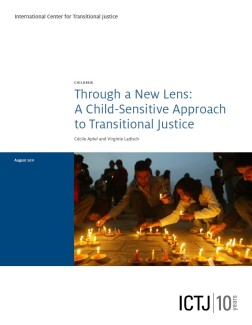
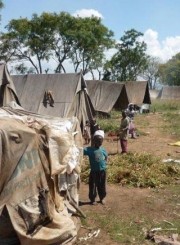
“Through a New Lens: A Child-Sensitive Approach to Transitional Justice” analyzes experiences of four countries—Liberia, Democratic Republic of Congo (DRC), Colombia and Nepal—and identifies some key lessons on children’s participation in transitional justice measures. Authored by Céc...

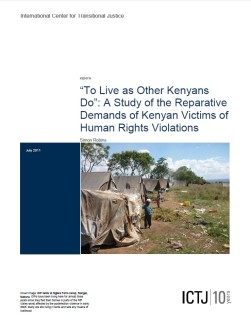
As Kenya continues to address its 2007-08 postelection violence, greater emphasis should be placed on victims’ reparative justice demands, according to a new ICTJ report. The report, “To Live as Other Kenyans Do”: A Study of the Reparative Demands of Kenyan Victims of Human Rights Violations, is a...

This paper documents the opinions of victims of human rights violations in Kenya about the country’s unfolding transitional justice process. The first section gives background into the human rights violations; the second section presents victims ideas about reparative justice. The rep...

ICTJ hosted a conference on “Strengthening Indigenous Rights through Truth Commissions” July 19-21, 2011. Regional and international experts convened to discuss how truth commissions can incorporate and address indigenous peoples’ rights. Videos of each session and summaries of the conference proceedings are available.

ICTJ's expert conference on the relationship between truth-seeking and indigenous rights is in session. View the live stream here.

“Residential schools affected everything about how we live. They targeted and destroyed our strong family unit, the basic foundation of our communities. They destroyed the glue that holds us together—love, respect and sharing.” These words, spoken by Charlie Furlong, a community leader of the Gwich'in people of Canada’s Northwest Territories, sum up the chilling legacy of the country’s policy of forced assimilation of indigenous cultures implemented through a system of Indian Residential Schools (IRS) from the 1870s to 1998.

The second Latin American Conference on Transitional Justice closed July 8. In the concluding remarks, ICTJ Truth and Memory Program Director Eduardo Gonzalez stated that while this conference has focused on sharing the comparative experiences throughout Latin America, this has not been an academic exercise but a call to action. Read more on the conference blog

Although Brazil's dictatorship ended years ago, focus on transitional justice there is peaking now, as debate stirs over how to best address its past. Recent developments - including the Brazilian government's proposal of a truth commission, the opening of national archives, and the Inter-American Court of Human Rights' decision limiting the 1979 amnesty law - are at the core of the discussion. Eduardo Gonzalez, director of ICTJ's Truth and Memory Program, discusses the role accountability for the past can play in Brazil today.