407 results

The transitional justice mechanisms the Mexican government put in place to investigate the grave human rights violations committed before the political transition of 2000 did not achieve their aims.

The issuance of the first sentences by Colombia’s Special Jurisdiction for Peace marks a turning point for transitional justice in the country. These historic convictions against those most responsible for war crimes and crimes against humanity committed during the armed conflict constitute the realization of justice and express both judicial and moral condemnation.

Colombia's Special Jurisdiction for Peace (SJP) aims to achieve criminal accountability through a mixed system of restorative and retributive justice. Generally speaking, the SJP envisions large-scale restorative justice measures involving public acknowledgments of responsibility, as ...

When 26-year old Tunisian street vendor Mohamed Bouazizi incinerated himself on December 17, 2010, his act resonated across an entire region and sparked what is known as the Arab Spring. His cry echoed across the world because it was a universal call for justice, basic fairness, and equal treatment. Indeed, it was a call for the rule of law. In a new op-ed, ICTJ's President David Tolbert calls upon the UN General Assembly to prove its commitment to justice and the rule of law.

On November 28, 2023, ICTJ organized an international dialogue in Bogotá, Colombia, to share innovative strategies for advancing victims’ rights to redress for human rights abuses and for establishing more victim-centered development policies. The gathering also marked the official launch of ICTJ’s new report—Advancing Victims’ Rights and Rebuilding Just Communities Local Strategies for Achieving Reparation as a Part of Sustainable Development—which presents findings from a two-year comparative study of local efforts in Colombia, The Gambia, Tunisia, and Uganda to advance reparations.


As the United States and global audiences were informed of the death of Osama bin Laden at the hands of U.S. special forces, we are reminded how crucially important justice is in the discourse on America’s fight against terrorism. On the eve of these momentous events, ICTJ President David Tolbert spoke to an audience at American University in Washington about the need for the U.S. to ensure accountability for the conduct of its “war on terror.”

The International Center for Transitional Justice (ICTJ) and the Barcelona International Peace Resource Center (BIPRC) are pleased to announce an Intensive Course on Transitional Justice and Peace Processes, taking place in Barcelona, Spain, June 6 - 10, 2016. It will focus on practical examples of recent or paradigmatic peace processes where the question of justice formed a significant part of the negotiating context.

ICTJ is pleased to announce an intensive course on transitional justice and peace processes to be held in Barcelona, Spain on October 9-13. Applications are now open.

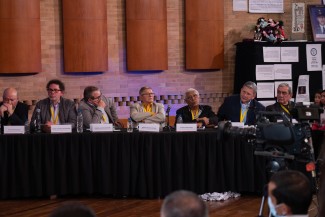
ICTJ welcomes the announcement of formal peace talks between the Government of Colombia and the National Liberation Army (ELN). This new process opens the possibility of achieving comprehensive peace in the country and entering a new phase in Colombian history.

A new book by ICTJ titled Justice Mosaics: How Context Shapes Transitional Justice in Fractured Societies examines the challenges of responding to massive human rights violations in different and difficult circumstances in today's world.