


64 results

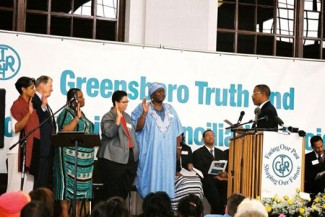
To mark 15 years of ICTJ, we asked staff past and present for the memories that stand out from their work. Former ICTJ consultant and Executive Director of the Truth and Reconciliation Commission in Greensboro, North Carolina Jill Williams reflects on her efforts to bridge a cultural gap in the pursuit of shared values.

Donald Trump is on a road to undermine the progress that decades of struggle has achieved - the time for action and resistance is now. The human rights movement must come together to resist his agenda, writes ICTJ President David Tolbert.

In this op-ed, ICTJ Vice President Paul Seils analyzes the criminal justice agreement announced by the Government of Colombia and the FARC and discusses what aspects of the deal need clarification to ensure that it is capable of delivering the kind of truth and justice that victims of Colombia's armed conflict deserve.

With the publication of the much-delayed US Senate Intelligence Committee’s partial report on the CIA’s Detention and Interrogation Program, at long last the truth is out. In this op-ed, ICTJ's President David Tolbert asks the United States to acknowledge the truth, hold the perpetrators accountable and address its obligation to the victims of its detention policies.

Many in Colombia are also interested in learning from international experiences where criminal accountability measures were applied to pursue justice after massive human rights violations, like in Bosnia and Herzegovina, Cambodia, Sierra Leone and East Timor. With the aim of promoting an exchange of ideas on what lessons could be useful for Colombia, the ICTJ will be holding a conference in Bogotá on November 24th.

In this edition of the ICTJ Program Report, ICTJ Senior Associate Felix Reátegui discusses the principles behind the Truth and Memory program, and explains the imperatives of uncovering, acknowledging, and memorializing the past.

The Maine Wabanaki-State Child Welfare Truth and Reconciliation Commission (TRC), the first of its type in the United States, marks one year of work.

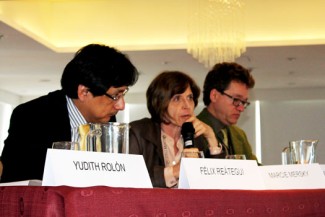
The one-day forum “Latin American Experiences with Truth Commissions,” organized by the International Center for Transitional Justice in Bogotá on July 22, brought together leading experts to discuss experiences and lessons learned from truth-seeking processes that shed light on massive human rights violations in four countries: Argentina, Guatemala, Paraguay, and Peru.

In this new opinion piece, ICTJ President David Tolbert says the United States has publicly lauded the rule of law as it applies to other countries and offered significant financial and political support to torture victims of foreign regimes; yet it has failed to acknowledge or address its obligation to victims of its own detention policies. To regain its credibility in the eyes of the world, the US government must take steps to acknowledge and address past violations and provide redress to victims of US-sanctioned abuses.

This opinion piece by Eduardo González, director of the Truth and Memory program at ICTJ, asks: can you build a solid, legitimate democracy on the sands of silence, or does truth provide a more trustful foundation?