

419 results

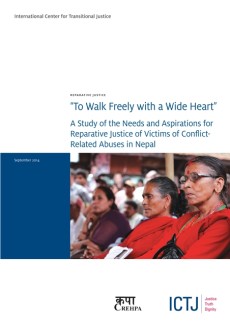
Annex to the publication, "'To Walk Freely with a Wide Heart' -A Study of the Needs and Aspirations for Reparative Justice of Victims of Conflict-Related Abuses in Nepal."

A new study by ICTJ finds that victims of human rights violations committed during Nepal’s 10-year armed conflict continue to experience hardship – and calls on the government to implement a comprehensive reparations program to respond to their acute and long-term needs.

This report presents the findings of an in-depth survey of more than 400 conflict victims in 10 districts of Nepal, researching their immediate and long-term needs and aspirations. Participants included those who had received benefits through the government’s Interim Relief Program an...

In this op-ed, ICTJ President David Tolbert says states are backsliding on their human rights commitments, and urges the international community to redouble its resolve for justice and accountability.

This manual was developed within the Framework Agreement for Cooperation between the International Center for Transitional Justice (ICTJ) and the Attorney General's Office in Colombia. This agreement was signed to provide technical assistance to the National Analysis and Context Unit ...

On August 7, the Extraordinary Chambers in the Courts of Cambodia (ECCC) found two senior leaders of the Khmer Rouge, Nuon Chea and Khieu Samphan, guilty of crimes against humanity. For many victims who have been waiting for 35 years, the judgment still felt like bittersweet justice.

This report is the result of research conducted by consultant Olga Lucía Gaitán for the International Center for International Justice (ICTJ) to analyze the rulings handed down by the Justice and Peace Chambers and the Criminal Chamber of the Supreme Court of Justice in Colombia. The ...

By this summer, dozens of paramilitaries and guerrillas in Colombia's Justice and Peace process will have already spent eight years in prison. In accordance with the law, those who fulfill their obligations to contribute to the truth and provide reparation to victims should be released after serving eight years. In this op-ed, ICTJ's Maria Camila Moreno analyzes the valuable lessons learned through this process.

Continuing political repression, cronyism, and ongoing conflicts are disrupting attempts to put Myanmar on a linear path to democracy, peace, and development, says a new report from the ICTJ. According to the report, titled “Navigating Paths to Justice in Myanmar’s Transition,” dealing with current and historical abuses is essential to achieving genuine progress on peacebuilding and economic development in the country.

This report asserts that dealing with past abuses in Myanmar is essential to achieving genuine progress on peacebuilding and economic development in the country. Conflict and high levels of political repression have racked Myanmar for more than half a century. Both President Thein Sei...