222 results

ICTJ hosted its third Intensive Course, Truth-seeking and the Challenge of Sustainable Peace, on September 26–30. Based on concrete field experience, the participants explored the relationship between truth-seeking and peace in societies that have experienced or are still experiencing armed conflict.

ICTJ applauds Brazil’s momentous step toward the creation of a truth commission and notes opportunities to ensure its success. Brazil’s Chamber of Deputies approved on Wednesday a bill creating the National Truth Commission to establish the facts and responsibilities about crimes committed under the country’s military regime.

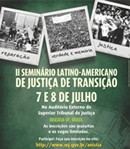
The second Latin American Conference on Transitional Justice closed July 8. In the concluding remarks, ICTJ Truth and Memory Program Director Eduardo Gonzalez stated that while this conference has focused on sharing the comparative experiences throughout Latin America, this has not been an academic exercise but a call to action. Read more on the conference blog

Although Brazil's dictatorship ended years ago, focus on transitional justice there is peaking now, as debate stirs over how to best address its past. Recent developments - including the Brazilian government's proposal of a truth commission, the opening of national archives, and the Inter-American Court of Human Rights' decision limiting the 1979 amnesty law - are at the core of the discussion. Eduardo Gonzalez, director of ICTJ's Truth and Memory Program, discusses the role accountability for the past can play in Brazil today.

This memorandum is a legal analysis of the applicability of the UN Convention on the Prevention and Punishment of the Crime of Genocide to events which occurred in Turkey-Armenia during the early twentieth century. It was drafted by independent legal counsel based on a request made to...

This study examines various aspects of existing reparations following the 1991-1999 conflicts in the former Yugoslavia. It clarifies the different categories of reparation; identifies groups potentially entitled to compensation; assesses the extent and fairness of existing policies; a...

The arrest of Ratko Mladic reignited debates on a wide spectrum of related issues, from its implications on the prospects for true reckoning with the past in the countries of the former Yugoslavia to the possible jolt it will give to Serbia’s hopes of joining the European Union. Beyond the immediate impact on the region, the strongest reverberations of Mladic’s transfer to the International Criminal Tribunal for the former Yugoslavia (ICTY) will be felt in the discourse on international justice.

This study identifies the range of agencies in and outside the former Yugoslavia that collect documentation on war crimes and other human rights violations committed in the 1991-1999 wars. Several factors that point to the need for an overview of data-collecting agencies in the region...

Since the end of open armed conflict in the former Yugoslavia, there has been little progress in transitional justice. This particularly applies to Serbia and Montenegro, which has lurched from one political crisis to another. This paper provides an overview of some of the major issue...

This paper provides an overview of the major issues and recent developments in transitional justice in Bosnia and Herzegovina (BiH). It examines the International Criminal Tribunal for the former Yugoslavia (ICTY), local trials, the proposed Truth and Reconciliation Commission, the Sr...