



276 results

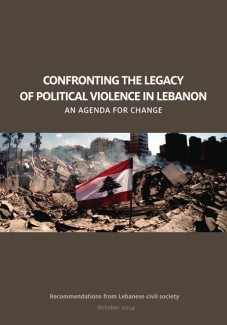
Lebanon should take firm steps to provide redress to victims of past conflicts and help prevent future violence, ICTJ and Lebanese rights groups said today at a roundtable discussion in Beirut. Lebanese authorities have mostly failed in their responsibility to end ongoing violations and ensure justice and truth for victims of the 1975-1990 war and successive conflicts.

This document presents wide-ranging recommendations for political and social reforms in Lebanon developed by a consortium of Lebanese civil society actors, as part of an ICTJ project. Directed at Lebanese authorities, the recommendations address the well-documented and widespread viol...

This report presents qualitative data collected by ICTJ on how individuals in Greater Beirut talk about the Lebanon wars and the need for truth, justice, and an end to violence in their country. For the study, 15 focus group discussions were held in 5 neighborhoods in Greater Beirut, ...

Transitional justice practitioners and activists from 18 different countries gathered in Barcelona to attend the 6th Intensive Course on Truth Commissions, organized by the ICTJ and the Barcelona International Peace Resource Center on September 29 - October 3.

In this op-ed, David Tolbert says Spain's democratic institutions exist side by side with long-term impunity, and argues that it's time for the country to address deep wounds that linger between different sides of the conflict.

In this op-ed, ICTJ's Refik Hodzic says that five years of a trial, thousands of documents and evidence exhibits, hundreds of witnesses, and hours testimony have not moved Radovan Karadzic closer to acknowledgement of the suffering he inflicted on countless lives.

This year, to mark the International Day of the Disappeared, we bring the story of Ziad and Ghassan Halwani, two brothers in Lebanon whose father was kidnapped and disappeared when they were young. Their story is a powerful testament to the long-term impact of disappearances on the life course of those who are still growing up.

Growing up in Ras el Nabeh, a lively neighborhood in the heart of Beirut, was tough and dangerous in the early 1980s, as it was part of the Green Line –a maze of abandoned streets inhabited by weeds turned into a frontline that vertically divided Christian East Beirut from Muslim West B...

In this op-ed, ICTJ Vice President Paul Seils argues that the front line of justice must always be national courts and justice systems. "Citizens must see social institutions at work in their home countries, as it is there that courts can repudiate wrongdoing and reaffirm the most fundamental elements of the contract that binds a society together. It is there that having the dignity of a citizen can have its fullest meaning," writes Seils on International Justice Day.

On International Criminal Justice Day, 2014, ICTJ joins the global celebrations marking the groundbreaking establishment of the Rome Statute in 1998, which created the International Criminal Court (ICC). To mark the day, we review five contexts where national systems proved it was possible to bring perpetrators to justice where it matters the most.