243 results

More truth commissions are being created now through peace agreements than at any other time in history. But are they living up to high expectations for truth, accountability, and reconciliation in societies emerging from violent conflicts? This week, the Kofi Annan Foundation and the International Center for Transitional Justice (ICTJ) held a three-day, high-level symposium to explore the challenges and benefits of truth commissions emerging from peace processes.

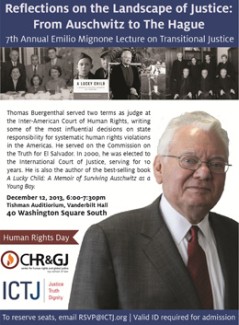
ICTJ and the Center for Human Rights and Global Justice at NYU School of Law are pleased to announce that Judge Thomas Buergenthal will be the speaker of the 7th Annual Emilio Mignone Lecture on Transitional Justice. Buergenthal is one of the world’s most distinguished jurists, whose name is synonymous with human rights and international justice. The lecture will be held on Thursday, December 12, from 6:00 to 7:30pm, in New York City.

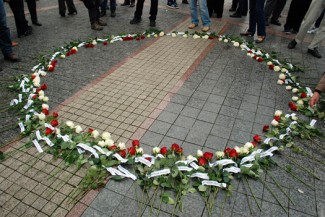
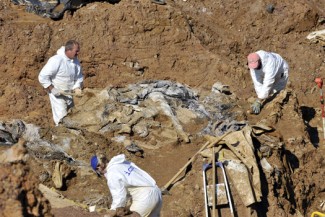
A group of leading world experts on truth-seeking and memorialization has called for the mayor of Prijedor, in Bosnia and Herzegovina, to publicly acknowledge and memorialize the non-Serb victims of atrocities committed in the city in the early 1990s.

A group of leading world experts on truth-seeking and memorialization has called for the mayor of Prijedor, in Bosnia and Herzegovina, to publicly acknowledge and memorialize the non-Serb victims of atrocities committed in the city in the early 1990s.

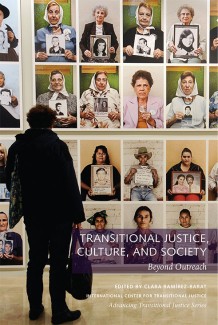
Enforced disappearances are among the cruelest of crimes. To the kidnapping, torture, and in many cases, murder of the victim, perpetrators intentionally create fear and uncertainty about the fate of the missing person. Although men are predominantly targeted, the impact on women is severe and lasting.

In the brutality of armed conflict or tyranny of a repressive regime, many who go missing are never found again: whether “disappeared” by agents of the state or abducted by an armed faction, the whereabouts of thousands are still unknown to this day. On this International Day of the Disappeared, ICTJ recognizes that enforced disappearances constitute crimes against humanity, and they affect women in ways unique from the impact on men.

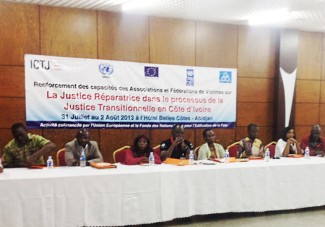
In Cote d’Ivoire, victims of the 2010-11 post-election violence have yet to receive reparations for violations that occurred during the political upheaval following the election of President Ouattara. Victims’ organizations in Cote d’Ivoire joined ICTJ and the ONUCI Human Rights Section for a three-day training session in Abidjan on reparative justice and the right to reparation.

ICTJ is launching a new multimedia page featuring projects that highlight the human perspective of issues in transitional justice and seek to engage a wide variety of audiences in a discussion on accountability for massive human rights abuses. Here's why we think multimedia can play a key role in deepening public understanding of transitional justice, and convey the guiding principles of ICTJ.

Thomas Buergenthal, Holocaust survivor and former judge of the International Court of Justice, is one of the world's most distinguished jurists. In conversation with ICTJ President David Tolbert, Judge Buergenthal shares his own personal story of surviving the Holocaust as a young boy, and reflects on the changing landscape of transitional justice around the world

Cote d’Ivoire has embarked on a process of addressing the legacy of internal strife that culminated in the post-election violence of 2010. On June 12, 2013, ICTJ will co-host high-level talks on strengthening Cote d’Ivoire’s judicial capacity to prosecute serious crimes proscribed by the Rome Statute of the International Criminal Court (ICC).