478 results

Can truth commissions help secure a just peace following a violent conflict in which massive human rights abuses are committed? In this special series of the ICTJ Forum, we present a series of conversations with some of the world’s top peace mediators and truth commission experts, whose collective experience include years on the front lines of critical peace agreements in Latin America, Africa, the Middle East, and Asia.

More truth commissions are being created now through peace agreements than at any other time in history. But are they living up to high expectations for truth, accountability, and reconciliation in societies emerging from violent conflicts? This week, the Kofi Annan Foundation and the International Center for Transitional Justice (ICTJ) held a three-day, high-level symposium to explore the challenges and benefits of truth commissions emerging from peace processes.

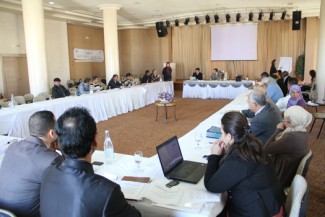
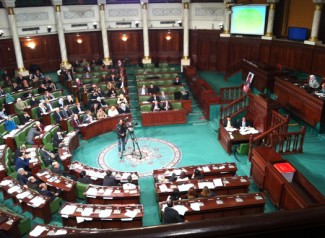
To offer assistance and international expertise to Tunisian civil society groups, ICTJ partnered with the Office of the High Commissioner for Human Rights (OHCHR) for a training on public engagement in truth seeking processes. Titled “The Role of Civil Society in Truth Commissions: Participation and Advocacy for Victims in Tunisia,” the training offered around 65 participants the opportunity to examine the role of truth commissions in contexts of transitional justice, and to assess future engagement of their organizations in Tunisia’s proposed truth commission.

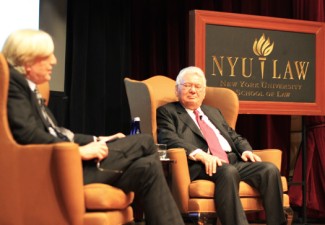
ICTJ and the Center for Human Rights and Global Justice at NYU School of Law are pleased to announce that Judge Thomas Buergenthal will be the speaker of the 7th Annual Emilio Mignone Lecture on Transitional Justice. Buergenthal is one of the world’s most distinguished jurists, whose name is synonymous with human rights and international justice. The lecture will be held on Thursday, December 12, from 6:00 to 7:30pm, in New York City.

A group of leading world experts on truth-seeking and memorialization has called for the mayor of Prijedor, in Bosnia and Herzegovina, to publicly acknowledge and memorialize the non-Serb victims of atrocities committed in the city in the early 1990s.

A group of leading world experts on truth-seeking and memorialization has called for the mayor of Prijedor, in Bosnia and Herzegovina, to publicly acknowledge and memorialize the non-Serb victims of atrocities committed in the city in the early 1990s.

A newly adopted UN Security Council resolution calls on the Syrian government to cooperate in destroying its chemical weapons arsenal, stressing that “those responsible for any use of chemical weapons must be held accountable.” Yet, it does not provide a framework for pursuing accountability, in the short or long term. What role might transitional justice play in a post-conflict Syria? Should Syria rush to prosecute war criminals once the fighting draws to a close? These are some of the pressing questions explored in ICTJ’s newest briefing paper.

This briefing paper focuses on establishing a credible approach to accountability and human rights in a post-conflict Syria. Looking ahead to an eventual resolution to the war, it recognizes that Syrian authorities and civil society, as well as the international community, will have t...

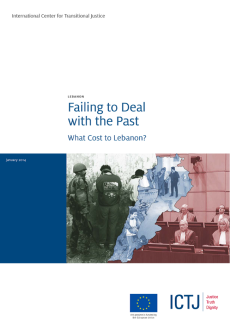
In this edition of the ICTJ Forum, we speak with Lynn Maalouf, one of the primary authors of a new report by ICTJ entitled Lebanon’s Legacy of Political Violence. The report compiles information on hundreds of incidents of serious crimes that took place from 1975 to 2008 in all parts of Lebanon.

This report compiles information on hundreds of incidents of serious human rights violations that occurred in Lebanon from 1975 to 2008, including mass killings, enforced disappearances, assassinations, forced displacement, and the shelling of civilian areas. It reveals patterns of vi...