421 results

Morocco’s “Years of Lead” period was marked by policies of state violence against political dissidents including torture, arbitrary detention, and enforced disappearances. “ Morocco: Gender and the Transitional Justice Process” analyzes whether the various transitional justice processes undertaken by the IER sufficiently fulfill the gender-specific focus of its mandate.

As ICTJ celebrates ten years of existence and contribution to the development of the field of transitional justice, we are poised for a future of continued engagement with partners and communities seeking to overcome legacies of mass violence and repression. Ten years on, we now work in a world increasingly aware of the of the costs of failing to systematically transition from conflict and human rights abuse to the rule of law and equal rights for all citizens, and on the other hand, of the increasing complexity of doing so.

Since 1990, 65 former heads of state or government have been legitimately prosecuted for serious human rights or financial crimes. Many of these leaders were brought to trial in reasonably free and fair judicial processes, and some served time in prison as a result. This book explores...

As the international community considers its response to the surging violence in Syria, those responsible for gross human rights violations in the country should be held to account, said the International Center for Transitional Justice (ICTJ) today.

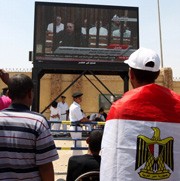
The appearance of Hosni Mubarak in the opening of his trial this week reassured millions of Egyptians that their revolutionary struggle was not in vain. But the truth about Mubarak’s ability to participate in his trial is still unclear. With the public doubting the court’s seriousness, Mubarak’s appearance could have been a political decision aimed at boosting confidence. If this is the case, the judiciary risks appearing politicized in the eyes of Egyptians.

This report describes the Supreme Iraqi Criminal Tribunal. It discusses the court's establishment and organization, jurisdiction, individual criminal responsibility, rules of procedure and evidence, and general principles of criminal law. It examines, in depth, the guidelines and fram...

The International Criminal Court (ICC) must better communicate what is driving its actions to the public of the Middle East and North Africa (MENA) and elsewhere around the world if it is to develop confidence in its capacity to act as a guardian of international criminal law.

This paper explores practical issues regarding the relationship between the Truth and Reconciliation Commission (TRC) and Special Court (SC) in Sierra Leone. It looks at: 1) the legal relationship of the Commission and the Court; 2) the question of whether the TRC information should b...

This report presents a study of ex-combatants' knowledge and opinions of the Truth and Reconciliation Commission (TRC) and Special Court (SC) in Sierra Leone. Ex-combatants and these accountability institutions are interdependent. Ex-combatants need the TRC and SC to help them reinteg...

This handbook explains the mandate, origins, purposes, and operating methods of the Truth and Reconciliation Commission (TRC) and Special Court in Sierra Leone. It discusses the differences and similarities between them, in clear, non-technical language. The TRC and Special Court can...