

106 results

Can truth commissions help secure a just peace following a violent conflict in which massive human rights abuses are committed? In this special series of the ICTJ Forum, we present a series of conversations with some of the world’s top peace mediators and truth commission experts, whose collective experience include years on the front lines of critical peace agreements in Latin America, Africa, the Middle East, and Asia.

ICTJ welcomes the 6th National Event of Canada's Truth and Reconciliation Commission, part of the TRC’s journey towards completion of its mandate: to learn the truth about what happened in the residential schools, and to inform all Canadians about this history.

Children and youth are especially vulnerable to the effects of conflict and gross human rights violations. In this edition of the ICTJ Program Report, ICTJ's Children and Youth Program Director Virginie Ladisch talks with us about the importance of integrating child and youth sensitivity into transitional justice mechanisms.

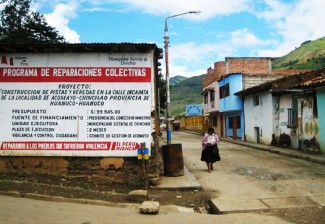
Reparations seek to recognize and address the harms suffered by victims of systematic human rights violations. ICTJ’s Reparative Justice program provides knowledge and comparative experience on reparations to victims' groups, civil society and policymakers worldwide. In this edition of the ICTJ Program Report, we look at ICTJ's work on reparations in dynamic transitional contexts such as Nepal, Colombia, Peru, DRC, and Uganda.

Elementary and high school teachers and students in the Montréal area gathered today for “Education Day,” an event convened by the Truth and Reconciliation Commission of Canada (TRC) to kick off the TRC’s historic Québec National Event, scheduled from April 24 to 27, 2013.

In this opinion piece, ICTJ's Sharanjeet Parmar asks: why do international efforts to tackle impunity for sexual violence in the DRC continue to miss the mark? High-level diplomatic visits are important in underscoring the responses needed for sexual violence survivors. However, without a strong political commitment from top Congolese authorities to address rampant impunity for sexual violence, no amount of attention or media coverage will reduce the violence or put an end to the cycles of suffering.

This opinion piece by Eduardo González, director of the Truth and Memory program at ICTJ, asks: can you build a solid, legitimate democracy on the sands of silence, or does truth provide a more trustful foundation?

From February 27-March 1, leading indigenous rights activists from around the world will join their counterparts and other experts at Columbia University to discuss access to truth, justice, and reconciliation for indigenous peoples.

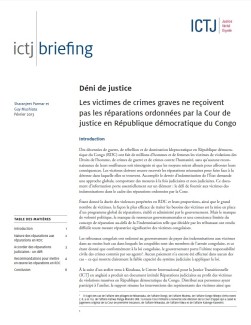
“Judgment Denied,” a report from the ICTJ, details four military court cases in the Democratic Republic of the Congo involving dozens of victims, egregious human rights violations, and nearly $1 million in outstanding awards owed by the government. In every case, serious crimes were committed against civilians by members of the Congolese Army, but the government has yet to pay compensation ordered by the courts.

Following field research in late 2009 and a 2010 workshop in Kinshasa, ICTJ produced a report in French on the challenges of enforcing court-ordered reparations. This briefing paper outlines and summarizes the challenges and recommendations discussed in the report. It also proposes ad...