231 results

ICTJ’s Middle East and North Africa Program, in partnership with the Arab Institute for Human Rights, the Tunisian League for Human Rights, and the Office of the High Commissioner for Human Rights, convened an international conference entitled “Addressing the Past, Building the Future...

As the number of victims of violence against demonstrators in Syria, Yemen, Bahrain and elsewhere in the region rises, a question emerges for the government of Bashar al-Assad of Syria, but also those of Ali Abdullah Saleh of Yemen, Hamad bin Isa al-Khalifah of Bahrain and the vacillating international community: Can impunity for such crimes be permitted in this day and age?

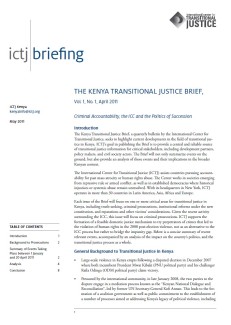
The Kenya Transitional Justice Brief, a quarterly bulletin by ICTJ highlighting current developments in the field of transitional justice in Kenya. This first edition provides a summary and analysis of developments surrounding the International Criminal Court's (ICC's) involvement in ...

Some habits die hard. This is especially true of ways of thinking. Despite significant changes in national and international law and practice in the last thirty years—the period that corresponds with the emergence of transitional justice as a field—the recent upheaval in the Middle East and Northern Africa region has provoked proposals that hearken back to a period that we may have thought long gone.

Background on the challenges in addressing legacies of past violence in sub-Saharan African countries such as Uganda, Ethiopia and Eritrea. The fact sheet gives an overview of the situation in the region and ICTJ's approaches in promoting transitional justice in individual countries. ...

A range of transitional justice measures should be considered in addressing the Kenyan crisis, including holding key perpetrators to account in a court of law, providing reparations for victims of the recent violence, and vetting security forces in order to remove those involved in ab...

The Commission of Inquiry into Post-Election Violence (CIPEV) was the outcome of the Kenya National Dialogue and Reconciliation Accord of February 28, 2008, negotiated by Kofi Annan and the Panel of Eminent African Personalities, and its sister agreement of March 4, 2008, known as Age...

The National Accord, negotiated in February 2008 by the Panel of Eminent African Personalities led by Kofi Annan, ended the months of violence that followed Kenya’s 2007 presidential election. The transitional justice mechanisms established by the accord have created an opportunity to...

Background on the challenges in addressing legacies of past violence in sub-Saharan African countries such as Uganda, Ethiopia and Eritrea. The fact sheet gives an overview of the situation in the region and ICTJ's approaches in promoting transitional justice in individual countries. ...

SEILS: ICTJ are delighted to host today a real giant in the world of political and legal struggle. Albie Sachs has not only played a huge and influential role in the development of the South African constitution but after being nominated by Nelson Mandela for 15 years in the new constitutional court...