

1519 results

Gender-based violence, including sexual violence was a common feature of the 10-year-long armed conflict between the security forces and the Communist Party of Nepal – Maoist (CPN-M), yet few individual incidents were reported.

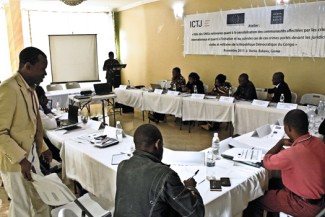
In meeting spaces in Goma, Bukavu, and Bunia, activists and magistrates are discussing ways that they can work together to improve the prosecution of international crimes in the region and address the concerns of local communities.

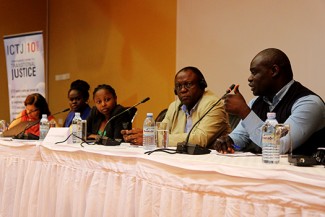
A new ICTJ report argues that in Africa's interconnected Great Lakes region, each country’s attempt to provide justice for past violations offers lessons for similar processes in others. We gathered civil society activists from across the region to discuss which strategies have worked for them, which have not, and opened up about the greatest challenges they face in securing justice.

It is an honor and a privilege for me to be with you for this important national conference. One year ago, on this exact same date, just three months after the Tunisian people impressed the world by peacefully ending decades of repression, I had the pleasure to speak at a conference ICTJ organized here in Tunis together with the Arab Institute for Human Rights, the Tunisian League for Human Rights and the UN Office of the High Commissioner for Human Rights. It was an important and lively debate on how to address the legacy of the past and move forward.

Humanitarians, development agencies, human rights organizations, and peacebuilding actors are commonly drawn to the same flash points of conflict, human rights violations, and states in need of rebuilding. Operating in common country contexts leads to increased interactions between th...

While Afghanistan goes through tremendous transition, it is important for justice and reconciliation actors to build transitional justice and gender initiatives based on experiences in other postconflict contexts.

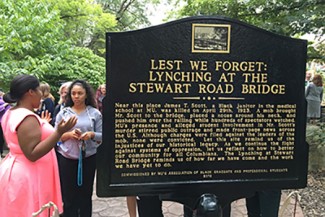
The removal of monuments to Confederate heroes is an important blow to the white-supremacy ideology that underpins ongoing racial injustices in the United States today, from mass incarceration to institutional violence. ICTJ President David Tolbert calls for a reckoning with these haunting injustices through memorials, acknowledgements and more.

ICTJ’s Middle East and North Africa Program, in partnership with the Arab Institute for Human Rights, the Tunisian League for Human Rights, and the Office of the High Commissioner for Human Rights, convened an international conference entitled “Addressing the Past, Building the Future...

This reference manual offers a template for developing and operating an internationally-assisted criminal justice institution. It provides a practical basis for setting up such an institution from an administrative perspective, drawing on numerous relevant practices currently used in ...

Invoking the principle of universal jurisdiction opens the door to the possibility of some accountability in circumstances where justice is not possible in countries where the crimes took place. This study considers the challenges facing the exercise of universal jurisdiction and asse...